
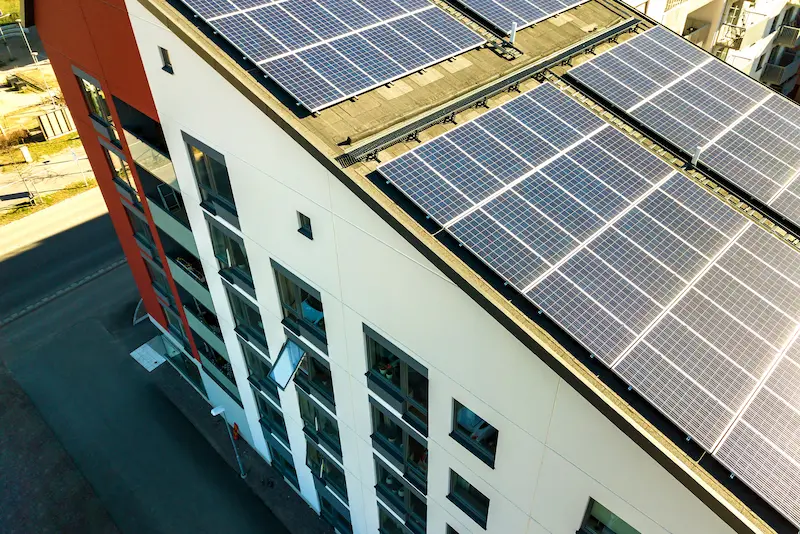
The installation of solar panels is no longer exclusive to single-family homes. More and more people living in blocks of apartments are wondering if it is possible to install solar panels in an apartment, and the answer is yes, although with certain nuances. Thanks to legislative advances and the promotion of shared self-consumption, today it is possible to benefit from solar energy even if you are living in a community of neighbors. That is why today, we are going to solve all the doubts about whether you can put solar panels in an apartment, its benefits, and how to do it. A complete guide for you to evaluate if this is feasible in your case. Keep reading!
Can I put solar panels on my apartment?
The possibility of putting solar panels on an apartment depends mainly on three factors:
- Ownership and access to the roof of your building.
- The type of solar installation you want to make (individual or collective).
- The consent of the community of owners.
Since the regulatory change introduced with Royal Decree 244/2019, it is now legal in Spain for several neighbors to share a photovoltaic installation through collective self-consumption. This makes it possible, for example, to install solar panels on the roof of the building to power several apartments, provided that certain technical and legal requirements are met.
What if I want to install panels only for my apartment?
It is also possible to do so, although it is usually more complex. If you have exclusive access to a communal terrace or roof terrace, you can propose an individual installation, but you will need the approval of the community by simple majority (according to the Horizontal Property Law, article 17.1).
In case the terrace or roof is for common use and not exclusive, the installation must be approved as a collective improvement and you will have to agree on the participation of the rest of the neighbors or assume the costs individually, if they agree to cede the space.
Benefits of having solar panels on an apartment
The benefits of installing solar panels in an apartment are very similar to those of a single-family house, although it has some additional positive particularities when it is done in a shared way. To begin with, the installation allows you to generate electricity for your own consumption, which in itself will reduce your electricity bill. Although the savings will depend on the number of panels installed, energy sharing and household consumption, it is usual that already to start with you will see a reduction of 30% to 60% in your bills, and can reach up to 70%. In addition:
- Shared profitability. By sharing the cost among several neighbors, the initial investment is significantly reduced. This makes the amortization faster and more accessible for families who would not be able to install a system individually.
- Sustainability. Solar panels reduce CO₂ emissions and dependence on fossil fuels. Installing panels on a block of apartments multiplies the positive impact, because more households benefit from a single renewable installation.
- Energy independence. Having photovoltaic self-consumption allows you to depend less on electricity price increases, so you gain more energy autonomy and predictability in your monthly expenses.
How to install solar panels in my apartment?
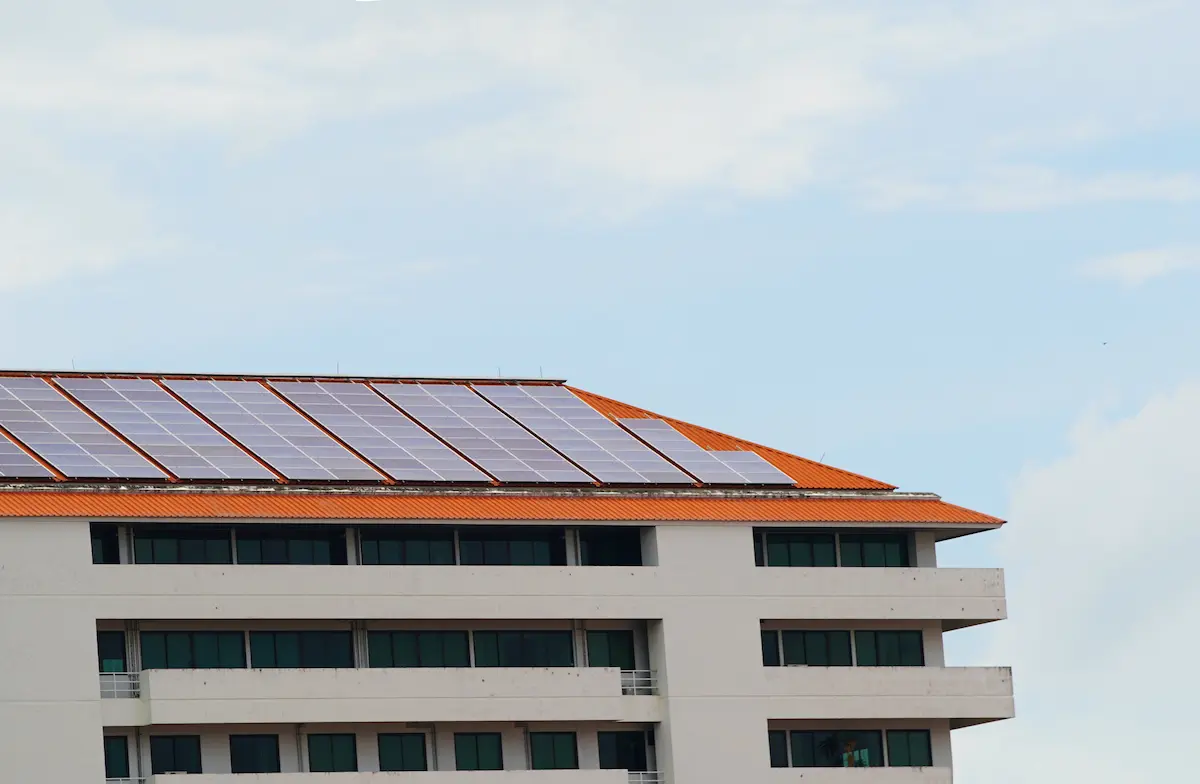
The process to install solar panels in a residential building will be different depending on whether it will be an individual or collective installation. However, in both cases, it is advisable to have a company specialized in self-consumption to carry out a technical, legal and economic study of your case. The step by step to install them would be:
- Feasibility study. The orientation of the roof, useful surface area, shading, electricity consumption and energy distribution possibilities are analyzed. This defines whether the installation is feasible and profitable.
- Proposal to the community of neighbors. If it is a collective installation, it is necessary to convene a meeting to discuss and approve the project by simple majority. The proposal must include the technical report, the budget and the distribution of consumption.
- Drafting the agreement. A participation agreement is signed that establishes which neighbors participate, how power is shared, who is responsible for maintenance, and what happens if someone wants to join or leave in the future.
- Application for permits. The building permits, prior communication or responsible declaration are processed at the corresponding city hall. In most cases, a building permit is not required.
- Execution of the installation. The installation company is responsible for assembly, legalization and commissioning. The whole process usually takes between 2 and 4 weeks from approval.
- Registration with Industry and surplus compensation. If you want to sell the surplus energy to the grid or compensate it in the bill, the installation must be correctly registered.
And how many solar panels may I need?
The number of solar panels that an apartment needs will always depend on several factors, such as the annual consumption of the household (in kWh), the distribution of the installation if it is collective, the efficiency and power of each panel, and the orientation of the roof.
In collective installations, a scalable system can be chosen: a common solar plant is installed and the energy is distributed proportionally to the consumption of each neighbor. For example, a building with 10 houses can install 40 panels and distribute the energy proportionally to those who participate. As a guideline, we leave you this table.
| Monthly consumption | Annual consumption | Plates required (approximate) |
|---|---|---|
| 200 kWh | 2,400 kWh | 4 – 6 panels |
| 300 kWh | 3,600 kWh | 6 – 9 panels |
| 400 kWh | 4,800 kWh | 8 – 12 panels |
Where is it forbidden to install solar panels?
Although the installation of solar panels is permitted almost everywhere in the country, there are some urban planning and technical restrictions that may limit or prevent their installation:
- Buildings in protected areas or with historical heritage, which require authorization from Heritage or the competent administration.
- Roofs with asbestos, which are prohibited by law for this type of installations.
- Roofs without sufficient structural strength, taking into account that the weight of the panels requires certain minimum safety requirements.
- Communities that do not authorize the use of the common space, since, if the necessary majority is not obtained, it cannot be installed.
- Rental housing without the owner’s agreement, since the tenant cannot install panels without express permission.
What permits are required to install solar panels at home?
The truth is that the permits required to install solar panels have been greatly simplified in recent years in order to promote self-consumption. However, some procedures are still necessary, especially if you want to legalize the installation and benefit from surplus compensation. First of all, bear in mind that some municipalities offer IBI rebates, and there are also European funds such as the Next Generation EU Plan, which can cover up to 40% of the investment. The most common permits you will need are:
- Agreement of the community of owners (in case of common space).
- Responsible declaration or previous communication in the town hall.
- Minor construction permit, only in specific cases depending on the municipality.
- Technical project and installation report signed by an authorized installer.
- Registration in the Self-consumption Registry of the autonomous community.
- Surplus compensation contract with the trading company (optional).
Conclusions
So, is it possible to install solar panels in an apartment? Yes, and not only can it be done, but it is increasingly recommended. Thanks to collective self-consumption, you can greatly reduce the cost of the panels and, adding public subsidies, living in an apartment is no longer an excuse to give up solar energy.
Although certain legal and technical requirements must be met, the process is affordable, cost-effective and very beneficial in the medium and long term. Whether you live in an apartment with your own terrace or share a roof with other neighbors, the possibility of installing solar panels is on the table.
Are you considering this option for your building or home? Contact us and we will help you evaluate your specific case, calculate the estimated savings and manage all the paperwork. Solar energy is also for you!


