
When we talk about renewable energy, what usually comes to mind are solar panels or wind turbines working throughout the day. But what happens when the sun is not shining or the wind is not blowing? This is where energy storage technologies become essential. One of the most promising solutions today is solar energy storage using molten salts.
In this guide, we explain how this system works, its main applications, and its advantages and disadvantages.
How Molten Salt Storage Tanks Work
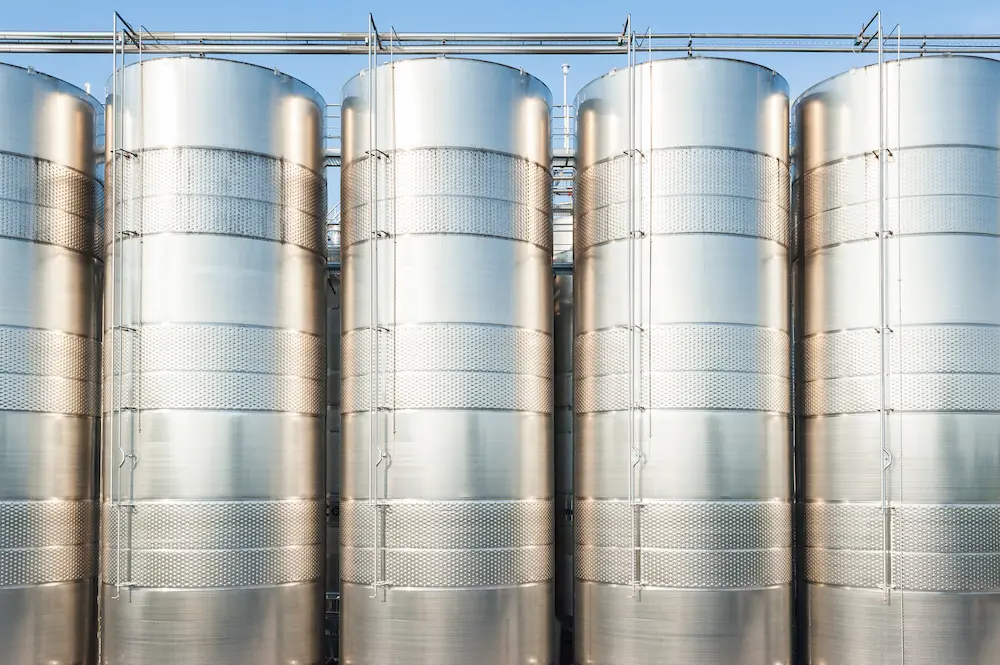
The basic principle is simple: store heat and release it when needed. Molten salts, typically a mixture of sodium and potassium nitrates, are heated to temperatures between 290°C and 565°C and stored in large steel tanks. The process works as follows:
- Solar energy capture. In a concentrated solar power plant, mirrors or heliostats concentrate solar radiation onto a central receiver.
- Heating the salts. The captured heat is transferred to the molten salts, which remain liquid at very high temperatures.
- Thermal storage. The hot liquid salts are stored in insulated steel tanks until electricity generation is required.
- Power generation. When demand increases, the stored heat is used to produce steam, which drives turbines and generates electricity.
This system allows electricity to be stored indirectly by converting solar radiation into heat and releasing it when needed.
Energy and Industrial Applications of Molten Salts
Molten salt energy storage is not limited to solar power plants. Several applications are already demonstrating its effectiveness and potential.
Concentrated Solar Power Plants
This is the most common application. Molten salts are widely used not only in Spain but also in countries such as the United States. They have become a standard solution to ensure continuous electricity production, even after sunset.
A well known example is the Gemasolar plant in southern Spain, a global pioneer capable of providing more than 15 hours of energy storage thanks to its molten salt system.
Industrial Processes
Molten salts are also highly useful in industrial processes that require constant heat, such as cement production, metal smelting, or food processing. These industries consume large amounts of thermal energy, and molten salts provide an efficient way to stabilise costs and reduce dependence on fossil fuels.
Hybrid Systems and Grid Stability
Another important application is integration into hybrid systems that combine solar, wind, or even biomass energy. Molten salts help stabilise the electricity grid by smoothing demand peaks and preventing drops in production. This results in a more balanced, reliable, and sustainable energy mix.
Advantages of Solar Energy Storage Using Molten Salts
Many countries are investing in this technology for several good reasons:
- High storage capacity, capable of retaining energy for hours or even days
- Lower relative cost compared to advanced battery systems, with a lower cost per stored kilowatt hour
- Long lifespan, often exceeding 30 years with proper maintenance
- High energy efficiency, thanks to minimal heat losses in well insulated steel tanks
- Improved sustainability, allowing maximum use of renewable energy without relying on backup fossil fuels
Disadvantages of Storing Energy in Molten Salts
Like any technology, molten salt storage also has some limitations that should be considered:
- Very high operating temperatures, requiring infrastructure capable of withstanding more than 500°C
- Geographical dependence, as the system works best in regions with high solar radiation
- Technical complexity, since tank design, pumping systems, and maintenance require specialised expertise
- High initial investment, even though long term costs are competitive
Comparison Between Molten Salts and Other Storage Technologies
To better understand the strengths and weaknesses of molten salt storage, here is a comparison with other energy storage solutions:
| Technology | Storage capacity | Lifespan | Cost | Main application |
|---|---|---|---|---|
| Molten salts | High (hours to days) | More than 30 years | Medium | CSP plants and industry |
| Phase change materials (PCM) | Medium | 15 to 20 years | Medium to high | Climate control and thermal processes |
| Lithium ion batteries | Medium to low | 8 to 12 years | High | Electronics and self consumption |
| Hydraulic storage systems | Very high (days to weeks) | More than 40 years | Medium to high | Large power grids |
How Is Energy Stored Using Molten Salt?
The process begins by heating the salt to a temperature between 500°C and 600°C until it becomes liquid. The molten salt is then pumped into a thermally insulated storage tank, where it can retain heat for days if necessary.
To recover the stored energy, the hot salt is pumped through a steam generator, which produces steam to drive a turbine and generate electricity. The heat can also be used directly for industrial processes. Step by step, the process is as follows:
- Heating and melting the salt
- Thermal storage in insulated tanks
- Steam generation
- Electricity production and delivery to the grid
This system requires three main components: storage tanks, a heat exchange circuit with pumps and pipes, and electricity generation systems such as steam turbines. In practice, molten salt energy storage is a clear example of how technological innovation can turn an intermittent natural resource like solar radiation into a continuous and reliable source of electricity. It can also be used as an energy carrier.


