
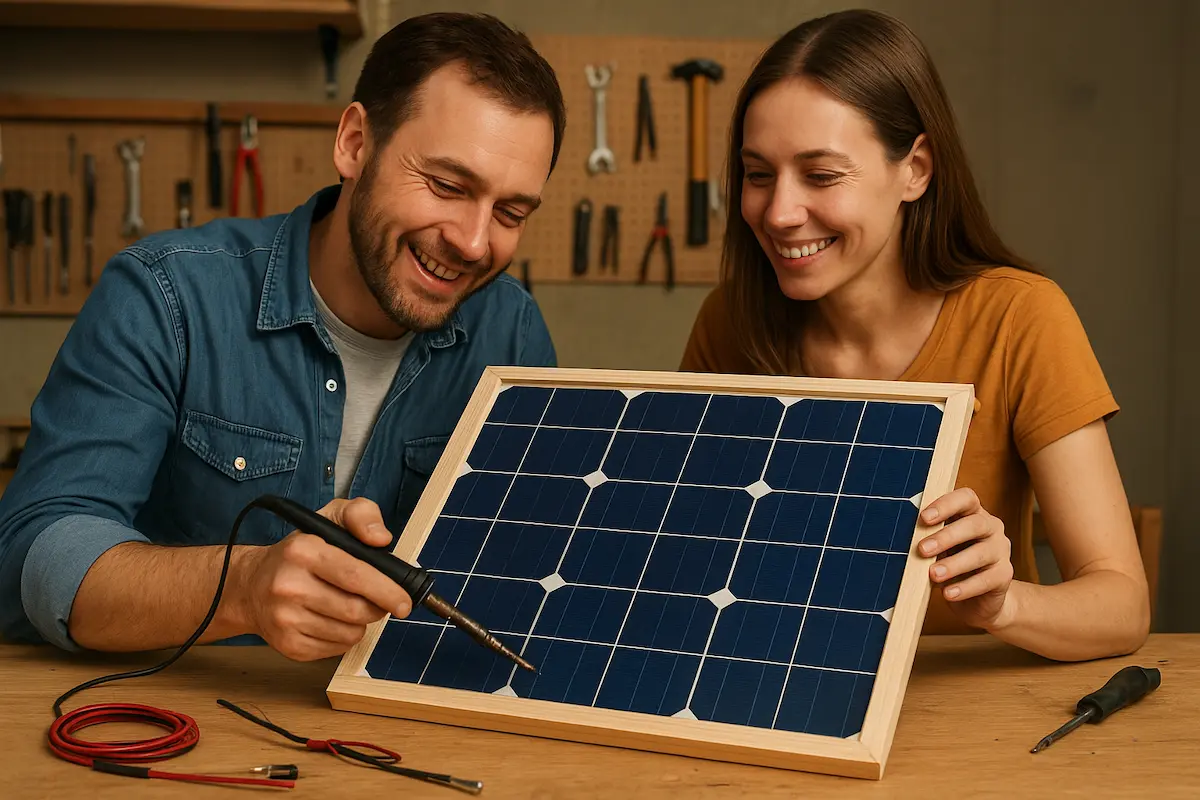
Making your own homemade solar panel is one of the most accessible, economical and educational ways to introduce yourself to the world of renewable energies. It not only allows you to reduce electrical consumption, but also offers you the opportunity to understand from the inside how a conventional solar panel works.
In this step by step guide we are going to break down the necessary tools, the materials you must use, the detailed assembly process and the recommendations to efficiently store the energy you generate, let us get to it.
Tools to manufacture solar panels
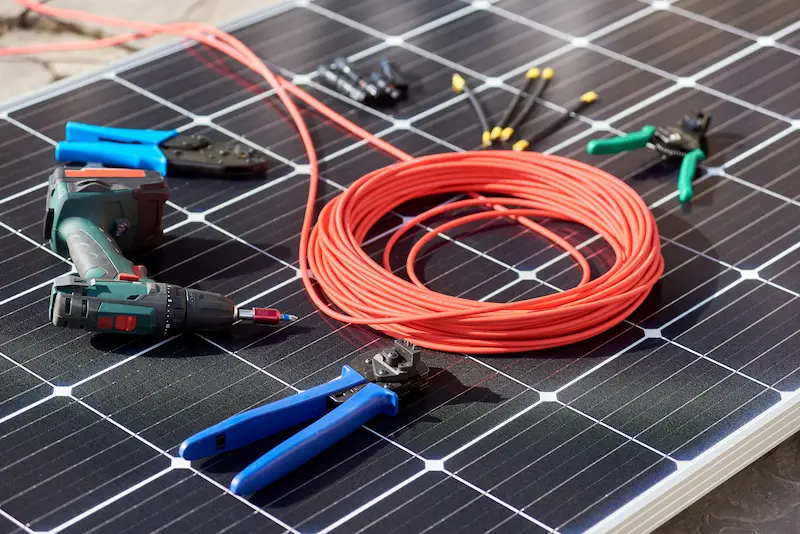
It is essential to gather a small kit of basic tools that will facilitate the whole process. Some are very common in any home, while others depend on whether you are going to make more advanced connections. What you are going to need yes or yes to make a homemade solar panel is this:
- Electric soldering iron (preferably fine tip)
- Soldering tin
- Multimeter to check the voltage and amperage of the cells
- Silicone gun or silicone sealant
- Cutter or powerful blade
- Scissors to cut copper tape
- Small pliers
- Insulating gloves
- Ruler and pencil to make a template
- Drill (if you want to create holes for the frame or the junction box)
As you can see you really do not need any professional machinery, but even so it is very important that you do all the work with great precision, because a bad contact, a poorly aligned cell or a deficient seal will drastically reduce the final efficiency of your panels.
What is needed to make a homemade solar panel?
We warn you first of all that the quality of the materials will greatly influence the durability of your panel, its energy efficiency and the possibility of using it for several years without losing performance. To make a homemade solar panel you must get these 8 materials:
- Non conductive support material. It can be treated plywood, rigid PVC or an ABS plastic sheet. Its function is to hold all the solar cells without risk of short circuit.
- Tempered glass for the front cover of the panel. It protects the cells without preventing the passage of sunlight. Tempered glass is resistant to impacts and temperature changes.
- Copper tape. The presoldered copper tape is necessary to electrically connect some cells with others. It is responsible for transporting the generated current.
- Encapsulant sheet (EVA or epoxy resin) to seal and protect the cells against moisture and dust, in addition, it helps prevent the connections from deteriorating over time.
- Solar panel frame, which will normally be made of aluminum or sealed wood. Thus, we keep the structure rigid and stable.
- Junction box. This is where the final electrical connections will be unified. Blocking diodes are also placed to prevent current return.
- Silicone or neutral sealant. Thus we will have a hermetic seal on edges and joints so that the panel is resistant to water and humidity.
- Presoldered solar cells. It is not that it is mandatory, but the most ideal thing is to already have the presoldered monocrystalline cells, since they come prepared with the contact strips, which facilitates assembly. They are efficient, economical and easy to handle.
How to make a homemade solar panel step by step
1. Prepare the base and the cells
Now yes, we move on to the process that will allow you to understand how to make a homemade solar panel from scratch, and preparation is the most important thing because a poorly aligned solar panel loses efficiency. Keep in mind that partial shadows, even if they are small, will reduce overall performance.
To start, create a design template. For this, you must place all the solar cells on the table and determine how many you are going to use and how they will be connected (series, parallel or combined). Draw a grid on the support with the exact positions and leave 2 to 3 mm between cell and cell to avoid cracks due to thermal expansion.
Then prepare the support, gently sanding its surface. Apply a layer of sealant or protector to prevent moisture from penetrating and make sure the base is completely smooth and clean. Keep in mind that the cells are extremely fragile, so handle them with care, by the edges and without pressing the front part so as not to break them.
2. Assemble the panels
Here we have to physically join the cells, which will form the solar panel. You will have to solder the connections:
- Place the copper tape over the metal strips of each cell.
- Use the soldering iron to fix it with tin without overdoing it.
- Connect the positive pole of one cell with the negative pole of the next.
To fix the cells to the base, apply small drops of transparent silicone behind each cell and place them one by one according to your template. Press gently until they are well adhered and check that you have no bubbles.
Now comes the encapsulation of the cells, which prevents corrosion and protects against impacts. You will have to use the EVA sheet (or epoxy resin) and uniformly cover the entire surface. Once encapsulated, put the tempered glass on top, making sure it is perfectly aligned. Then, seal the edges with the silicone. To finish assembling it, you must install the frame, which will give us rigidity and a more professional finish. Secure the corners with screws or adhesive and check that there is no space for water leaks, and you would have it.
3. Electrical connections
Without a good electrical connection, your solar panel will not be able to power any device, so it is important to do it safely.
Junction box
On the back part of the panel:
- Install the junction box.
- Join the cables coming from the cells.
- Place a blocking diode to prevent battery energy from returning to the panel when there is no sun.
Charge controller
The solar panel produces direct current, but needs a charge controller to prevent overloads in the battery. Connect the panel to the controller, and the controller to the battery.
Battery
The battery is to store the energy you generate when making your solar panel. Therefore it is best to use a deep cycle battery, however, check the voltage and capacity so they match the panel production.
Inverter
If you are going to use appliances that work with alternating current, you have to connect the inverter to the battery, since it is what will convert the energy so you can use common devices. With this you will already have an operational generation and storage system.
How much does it cost to make a homemade solar panel?
We already know how to make a homemade solar panel, but its cost will depend on the size you want to make it and the type of cell you choose, as well as the quality of the materials used. We are going to make a rough calculation based on a homemade panel of about 50 to 80 W of power.
- Presoldered cells: 25 to 45 €
- Tempered glass: 10 to 20 €
- Aluminum or wood frame: 10 to 18 €
- Copper tape: 8 to 15 €
- EVA or resin encapsulant: 10 to 25 €
- Sealant silicone: 4 to 8 €
- Junction box: 6 to 12 €
- Simple charge controller: 12 to 20 €
- Cables and accessories: 6 to 10 €
Doing the math the estimated total would be between 90 and 170€. This price is significantly lower than an equivalent commercial panel, but you must keep in mind that your homemade panel will not be as efficient. Obviously, its durability will also be less than that of an industrial panel and will require occasional maintenance. Even so, for learning, home projects or small consumption, the cost benefit is excellent.
How to store homemade solar energy?
Knowing already how a solar panel is made, you will have realized that without a storage system it is useful only when there is sun. To take advantage of the energy 24 hours a day, you need an efficient system. There are several options.
You have for example the ones we mentioned before, the deep cycle batteries, and they are the most recommended for renewable energy. They allow deep discharges without getting damaged, so they last a long time and are very stable, being ideal for low voltage homemade panels.
You also have lithium batteries, which are more expensive but more efficient. They have a longer useful life, weigh less and charge faster. Then there are supercapacitors, which are a fairly modern alternative system. They do not store as much energy as a battery, but they charge and discharge almost instantaneously.
Finally, if you only want to use the energy when there is sun, you can connect the panel directly to the inverter and consume at the moment. It is not the most recommended, but it works for small workshops or something more temporary. However, we advise you to always use a charge controller so there are no overloads, because otherwise, the battery will degrade very quickly.


