
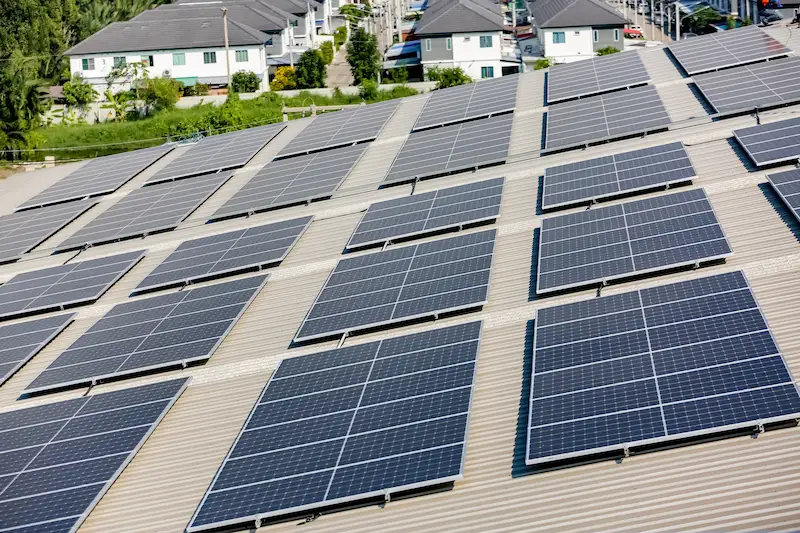
Collective self consumption is a model of renewable energy generation and use in which several individuals, companies or entities share a single photovoltaic installation to cover part or all of their electricity consumption. In other words, instead of each user installing their own individual solar panels, one shared system is built, usually on a common roof or plot of land, and all participants receive a proportional share of the energy produced.
This model makes access to solar energy much easier for those who cannot install an individual system due to economic, technical or space limitations. It also helps democratise the energy transition, allowing different users to benefit from clean, affordable and sustainable electricity without the need for large upfront investments. The key lies in shared management and energy distribution, which is carried out according to predefined coefficients agreed upon by all participants and validated by the electricity distributor.
Requirements for Collective Self Consumption
Spanish regulations clearly define how collective self consumption projects can be implemented. For a shared self consumption installation to be legal and operate correctly, several requirements must be met:
- Proximity of consumers. All consumption points must be connected to the same transformer substation and located within a maximum radius of 2,000 metres from the photovoltaic installation.
- Agreement between participants. All individuals or entities involved must sign an agreement establishing how the generated energy will be shared.
- Fixed distribution coefficients. Electricity distribution is based on fixed coefficients. These do not change according to real time consumption and remain constant over time, although they can be modified by mutual agreement.
- Registration in the self consumption registry. The installation must be registered in the corresponding regional or national self consumption registry so that the distributor and supplier can account for surplus energy and apply compensation when applicable.
- Individual metering. Each participant keeps their own electricity meter, which records both the energy drawn from the grid and the share received from the shared installation.
Types of Collective Self Consumption
Within collective self consumption, legislation recognises several models depending on how surplus energy is managed.
Collective Self Consumption With Surplus
This applies when the installation produces more energy than participants consume at a given moment. Instead of being wasted, the excess energy is fed into the electricity grid.
In this case, the installation not only supplies part of the users consumption but also contributes clean electricity to the overall power system. The surplus energy can provide an additional economic benefit rather than being lost.
With Simplified Compensation
In this model, the energy exported to the grid is compensated on the electricity bill. The energy supplier deducts the value of the surplus energy from the electricity that users have purchased from the grid during other periods of the month.
This is not a direct sale of energy but rather a credit system. The compensation cannot exceed the value of the energy consumed from the grid, so it does not generate direct income, but it does significantly reduce the electricity bill.
Collective Self Consumption Without Surplus
In this model, the installation is designed so that all generated energy is consumed instantly, with no energy injected into the grid. An export limiting system is installed to prevent surplus energy from being fed into the network.
This option is less common because it wastes part of the solar production when consumption does not match generation. However, it may be suitable in areas where local regulations restrict grid injection or where users want to simplify administrative procedures.
How Is Energy Distributed in Collective Self Consumption?
Energy distribution is not random and does not depend on real time consumption. It is based on fixed coefficients agreed in advance. These coefficients define the percentage of total production assigned to each participant. For example, in a building with ten apartments that installs solar panels on the rooftop, each apartment may receive 10 percent of the energy. Alternatively, different percentages can be assigned based on each participant contribution to the initial investment or their expected consumption.
The electricity distributor automatically applies these coefficients when calculating bills. Each consumer receives their allocated share of generated electricity and, if there is surplus, compensation is applied according to their coefficient. Everything is defined in a contract signed by all participants, which helps prevent conflicts.
Who Can Use Collective Self Consumption?
Collective self consumption can be implemented in many different environments:
- Industrial estates. Companies sharing warehouses or buildings can install a common solar plant and share the benefits, reducing energy costs and improving sustainability.
- Residential buildings. Homeowners associations can install solar panels on the rooftop and distribute the energy among residents. There are two main approaches:
- Basic, where energy is used for common areas such as lifts or lighting
- Full, where energy is also allocated to individual homes and commercial units
- Residential neighbourhoods. Several nearby single family homes can jointly invest in a shared installation on common land or on one of the houses.
- Schools and educational centres. Schools, universities and institutes with large roof areas can install solar panels and distribute energy across different facilities, reducing costs and promoting sustainability values.
- Public entities. Local councils and other public bodies can also benefit from collective self consumption projects.
Benefits of Collective Self Consumption
Collective self consumption is one of the most effective ways to move towards a fairer and more sustainable energy model. Its main benefits include:
- Economic savings. Sharing an installation reduces upfront costs and maintenance expenses, making solar energy accessible to more people.
- Access to renewable energy. Even users without their own roof or suitable space can benefit from photovoltaic energy.
- Reduced dependence on the grid. By generating their own electricity, participants rely less on conventional power and are better protected against price volatility.
- Environmental sustainability. Every kilowatt generated from solar energy avoids CO2 emissions.
- Stronger social cohesion. Collective self consumption projects encourage cooperation between neighbours or companies and promote shared responsibility in the energy transition.


