
Industrial technology has advanced by leaps and bounds, and at the heart of many of these innovations are motor control systems. In the past, electric motors operated at a fixed speed, limiting efficiency and control in many applications. However, with the advent and evolution of devices such as the variable frequency drive, the way industries manage and optimize their processes has been revolutionized. This article will guide you through everything you need to know about this key piece of modern engineering, breaking down what a variable frequency drive is and, more importantly, what a variable frequency drive is for. Get ready to understand how this technology can transform operational efficiency and control in your industry.
What is a Variable Frequency Drive (VFD)? Basic Concepts
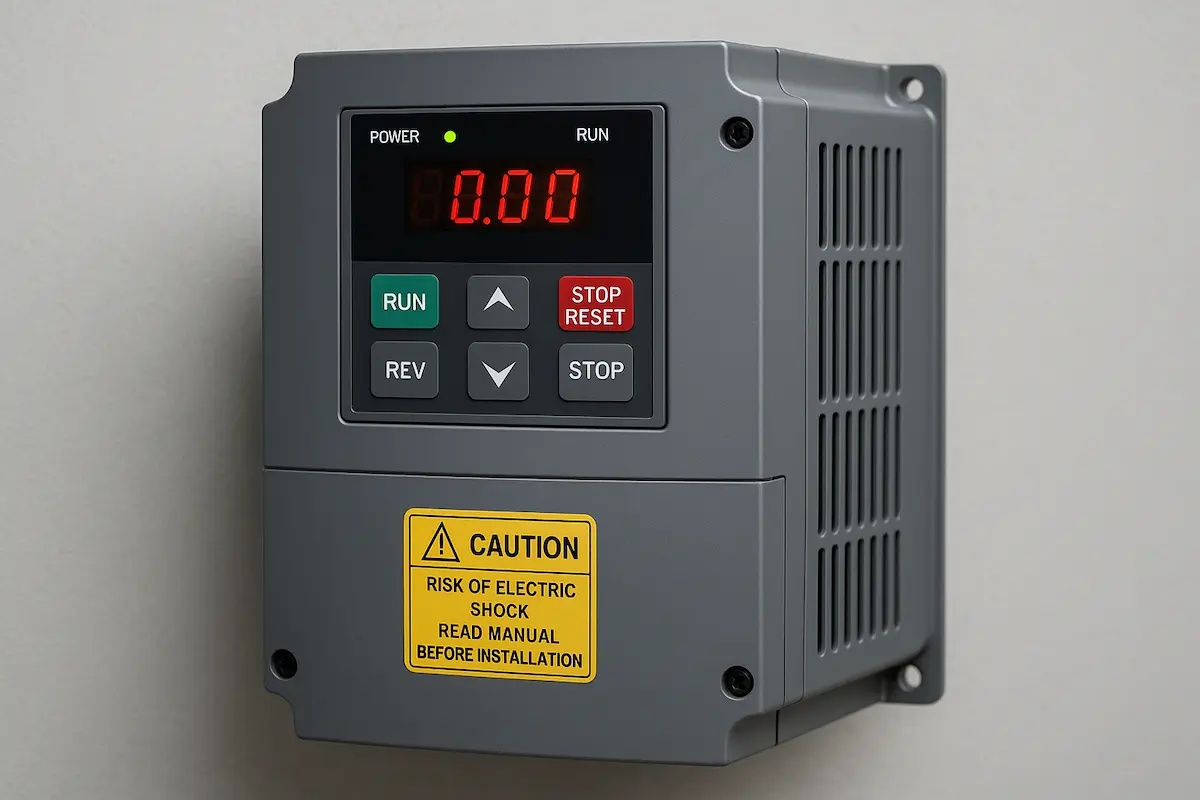
A variable frequency drive (VFD), also known as a frequency inverter or frequency converter, is a sophisticated electronic device designed to control the speed of alternating current (AC) electric motors. Its main function is to adjust the frequency and voltage of the power supply reaching the motor, thus allowing precise variation in its rotational speed.
Key Components
To understand how it works, it is useful to know its main components:
- Rectifier: It is the first stage of the VFD. Its function is to convert the alternating current (AC) input from the mains into direct current (DC).
- Direct Current Bus (DC Bus): Acts as an energy “reservoir”, storing the rectified DC current and smoothing out fluctuations before it is passed on to the next stage.
- Inverter: This is the final and most crucial stage. The inverter takes the direct current from the bus and converts it back to alternating current (AC), but with a variable frequency and voltage as needed.
How does a variable frequency drive work?
The process is ingenious and can be understood with a simple analogy:
Imagine a VFD as a faucet that regulates water flow. The main pipe (the mains) always delivers water at a constant pressure and flow rate (fixed voltage and frequency). However, the faucet (the VFD) allows you to partially open or close it to get the exact water flow you need (motor speed).
In technical terms, the VFD performs a double conversion: first, it rectifies the AC current from the grid to DC current. Then, using power transistors, the inverter “creates” a new AC output waveform, which can have a specific frequency and voltage, different from the input. This flexibility is what allows the VFD to control motor speed so precisely.
What is a Variable Frequency Drive for? Applications and Benefits
The utility of a variable frequency drive is vast and translates into significant benefits for a variety of industries.
Precise Speed Control
The main reason to implement a VFD is its ability to adjust the motor speed to the specific needs of the application. This is crucial in scenarios where constant speed is not optimal.
For example:
- Fans and Pumps: Instead of constantly running at maximum capacity, a VFD allows them to adjust their speed to meet actual demand, resulting in considerable energy savings.
- Conveyors: Speed can be varied to control the flow of materials on a production line.
- Elevators: Allow smooth starts and stops, improving comfort and reducing mechanical wear.
Energy Saving
One of the most attractive benefits of VFDs is energy savings. In applications where the load varies, such as pumps and fans, power consumption is proportional to the cube of the speed. This means that a small reduction in speed can generate substantial energy savings. By preventing motors from running at their maximum speed unnecessarily, energy consumption is drastically reduced, directly impacting the reduction of operating costs and a company’s carbon footprint.
Improved Performance and Service Life
Variable frequency drives contribute to the longevity and efficiency of machinery in several ways:
- Reduced mechanical wear: By allowing soft starts and stops (acceleration and deceleration ramps), mechanical stress and current peaks that occur in direct starts are avoided. This significantly reduces wear on components such as gears, belts and bearings.
- Motor torque control: VFDs can control torque, which is vital in applications requiring constant torque or precise force control.
- Improved product quality: In manufacturing processes, precise speed control can lead to higher quality and uniformity in the final product.
Common Applications of Variable Frequency Drives
Variable frequency drives are ubiquitous in modern industry, found in a wide range of sectors:
- Pumping and ventilation systems (HVAC): They regulate the flow of water and air in buildings and industrial processes, optimizing energy consumption.
- Industrial automation (production lines): They control the speed of conveyors, mixers and other machines on assembly lines.
- Machine tools: Allow to adjust cutting speed and precision on lathes, milling machines, etc.
- Cranes and hoists: They provide smooth and precise control of the lifting and movement of heavy loads.
Variable Frequency Drive vs. Frequency Converter: Are they the same?
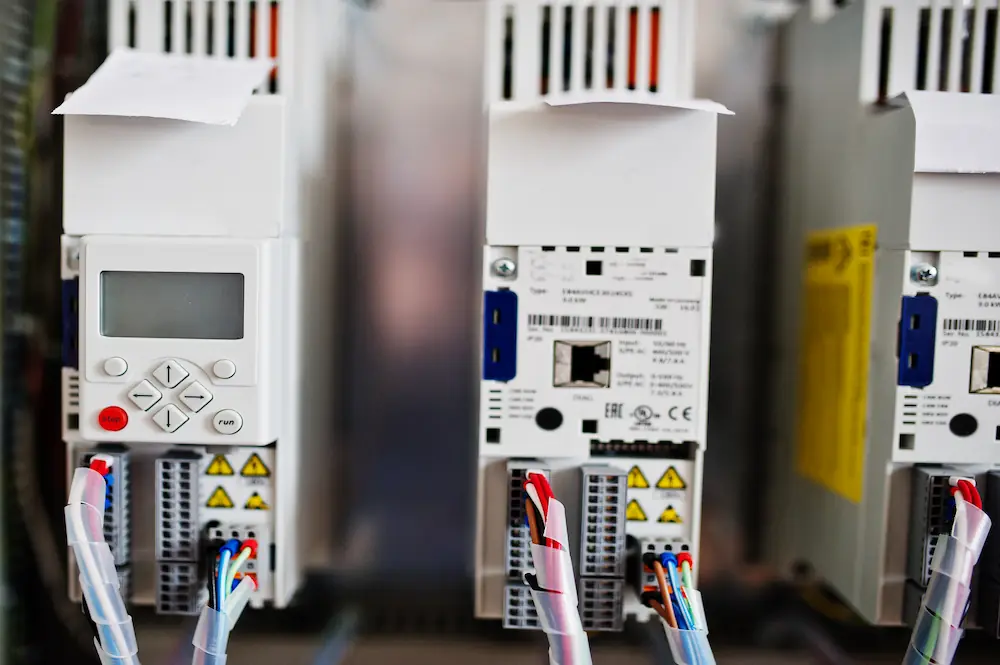
It is common for doubt to arise as to whether a variable frequency drive and a frequency converter are the same thing. In most industrial and technical contexts, yes, they refer to the same device. “Frequency converter” is an equally valid term and is used interchangeably with “frequency inverter”. Other designations you may hear include “frequency inverter” or “variable frequency drive (VFD)”. All of these expressions point to the same electronic equipment designed to control the speed of AC motors by varying the frequency and voltage.
Key Advantages of Implementing a Variable Frequency Drive
The implementation of VFDs is not only a trend, but a smart strategy to improve efficiency and profitability.
Energy Efficiency
As mentioned, energy savings is one of the cornerstones of VFD utility. On average, VFDs can generate energy savings of 20% to 50% in pump and fan applications, and significant savings in other types of machinery. These savings quickly translate into a favorable return on investment (ROI), often within a few months to a couple of years, depending on the application and energy cost.
Reduced Maintenance and Increased Reliability
VFD-controlled operation minimizes stress on the equipment. Soft starts prevent mechanical and electrical overloads, resulting in:
- Reduced need for spare parts: By reducing wear, the service life of components such as bearings, couplings and belts is extended.
- Less downtime: Fewer unexpected failures means more continuous and reliable production.
Operational Control and Flexibility
VFDs offer unprecedented operational flexibility:
- Adaptation to different processes and workloads: A motor can be programmed to operate at different speeds according to changing production needs.
- Integration with automation systems: Modern VFDs are compatible with various industrial communication protocols (Modbus, Profibus, Ethernet/IP), allowing easy integration into broader control systems, such as PLCs and SCADA systems.
Considerations When Choosing a Variable Frequency Drive
Selecting the right VFD is critical to maximizing your benefits. Here are some important factors to consider:
- Motor type and power: The VFD must be compatible with the motor type (asynchronous, synchronous, permanent magnet) and its power rating.
- Specific application: The characteristics of the application (constant or variable torque, type of load, speed range) will influence the choice of VFD.
- Environmental conditions: Temperature, humidity, altitude and the presence of dust or corrosive agents are crucial factors that determine the degree of protection (IP) and the required robustness of the VFD.
- Additional functionalities: Some VFDs offer advanced features such as integrated harmonic filters, regenerative braking, STO (Safe Torque Off) safety functions or advanced communication capabilities.
VFD Typical Application Comparison and Requirements Table
| Application | Type of cargo |
Key VFD Requirements
|
| Pumps and Fans | Variable torque |
Energy saving, PI control, bypass
|
| Conveyors | Constant torque |
Torque control, smooth ramps, braking
|
| Machine Tools | Constant/variable torque |
High precision, vector control, dynamic
|
| Cranes and Hoists | Constant torque |
Regenerative braking, safety, precise control
|


