

The buffer tank generates quite a few doubts because for some installers it is essential; for others, dispensable depending on the type of system, and for you as end users, directly a great unknown that appears in the budget without being clear what it is for or if they really need it.
The truth is that the buffer tank fulfills a key function in many aerothermal systems, especially when we talk about efficiency, thermal stability and durability of the equipment. It is not a simple extra, but a component that, well dimensioned and correctly integrated, can make the difference between an installation that works optimally and another that generates unnecessary consumption or medium term problems. Let us see exactly what it is.
What is a buffer tank?
A buffer tank is, in essence, a thermal energy accumulator. It is a tank that stores hot water (or cold, depending on the operating mode) to stabilize the climate control system and improve its performance.
Its main function is not to produce heat or cold, but to store it temporarily and release it when the system needs it. This allows the aerothermal energy to work more continuously and efficiently, avoiding constant starts and stops of the compressor. Therefore:
- Increases the water volume of the system.
- Smooths temperature variations.
- Improves hydraulic stability.
- Reduces equipment wear.
It is important not to confuse the buffer tank with a DHW (domestic hot water) accumulator. Although both are tanks, they fulfill completely different functions. The buffer tank works for climate control (heating and cooling), not for domestic water consumption.
Types
Of course, there are some with different characteristics and configurations, so we are going to detail the main aspects that you must take into account:
- The tank content. The usual content of a buffer tank is pressurized water, which may or may not carry antifreeze (such as glycol), especially in installations where there is a risk of frost or in outdoor circuits. The use of antifreeze must be calculated correctly, since it affects the thermal capacity of the system.
- Tank capacities, which can vary from 30L in small models to 500L in high power installations. We recommend an approximate capacity of between 16 and 30L for each kW of thermal power in the heat pump.
- Tank material, the most common being carbon steel with anti corrosion treatment or stainless steel.
- Types of buffer tanks according to their design and function: simple ones, buffer tanks with hydraulic separator, combined ones (buffer plus DHW) and those with internal coils.
How does a buffer tank for aerothermal energy work?
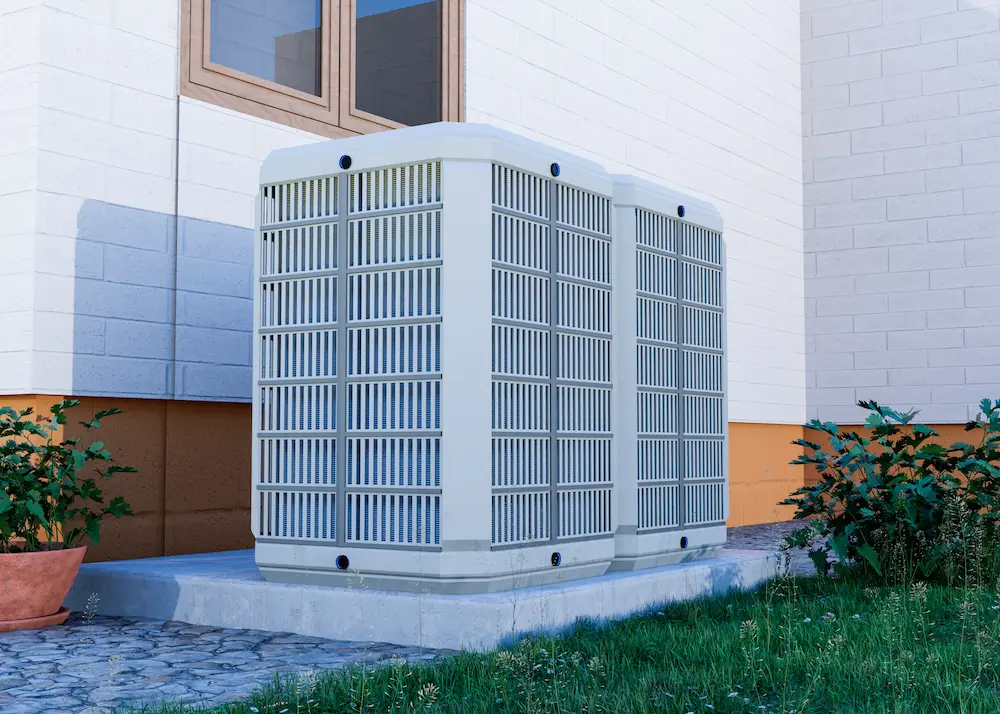
The operation of a buffer tank for aerothermal energy is based on a very simple principle, increasing the thermal mass of the system.
When the heat pump generates heat or cold, it is transferred to the circuit water. If the water volume is reduced, the temperature rises or falls very quickly, causing the system to turn off upon reaching the setpoint and start again shortly after. This is what is known as short cycles. The buffer tank introduces an additional volume of water that absorbs the excess thermal energy, releases it progressively and allows the aerothermal energy to work for more time continuously.
In practice, the tank acts as an intermediary between the heat pump and the emitters (underfloor heating, radiators, fancoils), ensuring a more stable flow and temperature. This is especially important in systems with low inertia emitters, installations with thermostatic valves and homes with variable thermal demands.
Benefits of a buffer tank
Installing a buffer tank in aerothermal energy provides multiple advantages, both from the energetic and mechanical and comfort point of view. Among the main benefits stand out:
- Greater energy efficiency. By reducing starts and stops, the system works in more efficient operating ranges, which translates into lower electrical consumption.
- Less wear on the compressor. Short cycles are one of the main enemies of heat pumps. The buffer tank extends the useful life of the equipment.
- Greater thermal stability. The system temperature remains more constant, improving comfort in the home.
- Cold storage, since during the hours where there is less demand, which is usually at night, it can generate and accumulate cold water in the tank, being available throughout the day to use.
- Better operation with underfloor heating. Underfloor heating particularly benefits from the additional thermal inertia, since it works at a low temperature and continuously.
- Hydraulic flexibility. It facilitates system balancing when there are several circuits or zones with different demands.
- Compatible with solar thermal panels, storing excess heat if you do not need it.
When is a buffer tank necessary in aerothermal energy
Not all aerothermal installations necessarily need a buffer tank, but there are situations where its installation is highly recommended or even essential. It is usually necessary when:
- The total water volume of the system is low.
- Low thermal inertia emitters are used.
- There are many thermostatic valves that open and close circuits.
- The power of the heat pump is high in relation to the real demand.
- Frequent short cycles occur.
Instead, in well dimensioned systems with underfloor heating, sufficient water volume and correct modulation of the heat pump, the buffer tank may not be strictly necessary, although it remains an additional guarantee of stability.
The key is to analyze each installation individually, avoiding standard solutions that are not always the most efficient.
How to calculate the buffer tank in aerothermal energy?
Correctly calculating the size of the buffer tank is fundamental. A tank that is too small will not fulfill its function, and an oversized one will mean an unnecessary cost and greater thermal losses. As a general reference, between 16 and 30 liters are recommended for each kW of thermal power of the aerothermal energy.
For example:
- For an 8 kW heat pump, the recommended tank would be between 130 and 240 liters.
- For a 12 kW installation, between 190 and 360 liters.
However, this calculation must be adjusted taking into account:
- Type of emitters (underfloor heating, radiators, fancoils).
- Existing water volume in the installation.
- Main use (heating, cooling or both).
- Control and modulation strategy of the equipment.
The buffer tank in aerothermal energy is one of those components that are not always seen, but that have a direct impact on the operation, efficiency and durability of the system.
Understanding what it is, how it works and when it is necessary allows making more informed decisions, avoiding design errors and getting the most out of a technology as efficient as aerothermal energy.


