
A natural and sustainable thermal insulator is a material that reduces heat transfer between the interior and exterior of a building, manufactured from renewable, recycled sources or without aggressive chemical treatment. They are an environmentally friendly alternative to traditional synthetic materials, with the advantage of being biodegradable and less polluting. Today, we tell you all about the best natural, homemade and commercial thermal insulators.
Types of thermal insulators
There are three main types of thermal insulators: natural, ecological and commercial.
Ecological thermal insulators
They are natural materials that come from renewable or recycled sources, such as cork, sheep wool, cellulose, wood fiber or hemp. They are biodegradable, non-toxic and very efficient.
Homemade thermal insulators
Homemade thermal insulation materials are solutions that you can apply yourself with affordable or recycled materials. They may not be as efficient as the professional ones, but they are useful in specific situations, as something temporary, for windows, doors, floors…
Commercial thermal insulators
They are products developed by industry to deliver high performance. Not all of them are natural, but there are sustainable and environmentally friendly options. Some examples: rock wool panels, polyurethane foam, or expanded cork panels.
5 best natural thermal insulators
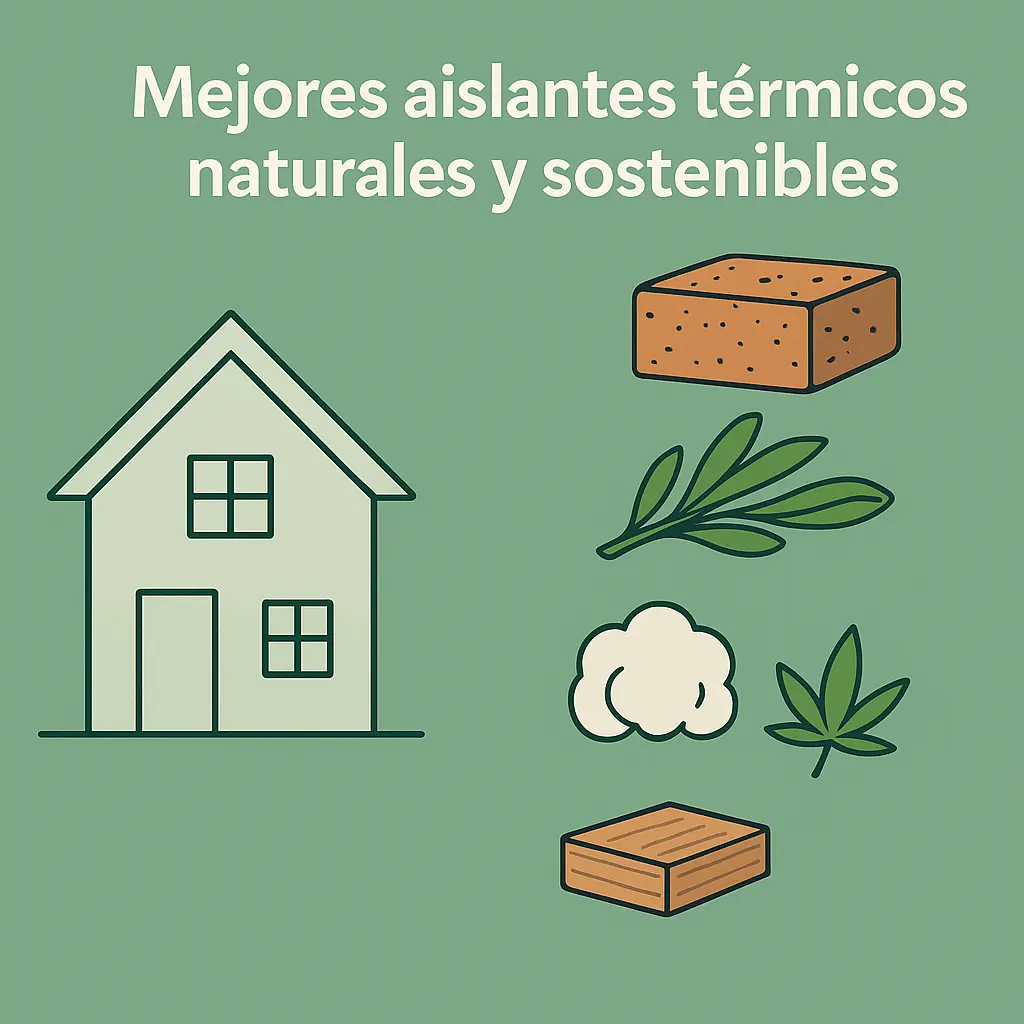
If you are looking for ecological and sustainable thermal insulators, here are five natural materials that stand out because they are very versatile and effective, while respecting the environment.
Cork
Cork is one of the best known natural insulators. It is extracted from the bark of the cork oak tree and has exceptional properties. In addition, it is 100% recyclable and has excellent durability. It is one of the best natural insulators for exterior walls because:
- It is very resistant, both thermally and acoustically.
- It is also resistant to water, mildew and insects.
- It does not require chemical products for its treatment.
- It is the best for facades, roofs or floors.
2. Posidonia algae
Little known but highly effective. Dried Posidonia oceanica seaweed (a marine plant from the Mediterranean) is harvested naturally when it reaches the coast and does not require chemical treatment. In addition, they provide a natural regulation of the humidity of the environment, making them perfect for humid climates.
They are moisture and fire resistant, have a very low carbon footprint, and can be used in partitions, ceilings or floors.
3. Cotton
Recycled cotton, especially from reused textiles, is an environmentally friendly and low-cost thermal insulator. It comes in panels or blankets and is very easy to install. It does, however, require fireproofing treatments to ensure fire safety.
- It has good thermal and acoustic resistance.
- Adapts well to irregular spaces.
- It is breathable and prevents condensation.
4. Wood fiber
This material is obtained from the recycling of wood waste. It is manufactured in the form of rigid or semi-rigid panels. It works very well in both walls and roofs, and is compatible with green building systems. It has:
- High insulating capacity and good thermal inertia.
- Good fire resistance (if treated).
- Ambient humidity regulation.
5. Hemp
Hemp is one of the most complete natural thermal insulators: fast growth, low environmental impact and excellent performance. It comes in the form of panels, rolls or blocks. It is ideal for renovations or sustainable construction.
It has good thermal and acoustic insulation capacity, is resistant to pests and fungi and is very durable and easy to handle.
Best commercial thermal insulator
Although natural insulators are gaining ground, some commercial products are still the most efficient option when very high insulation is required in a small space. The best example is sprayed polyurethane foam, which is applied in liquid form and expands to cover gaps, creating a continuous seamless layer. It has great advantages:
- Very high thermal insulation (low conductivity).
- Excellent performance against leaks and thermal bridges.
- Good quality/price ratio.
However, it is not an environmentally friendly material, and should be used only when it is not feasible to install natural insulation.
What is the best home thermal insulator?
If you are looking for the best, fast and economical solution among home thermal insulators is, without a doubt, polyurethane spray foam. You can buy it anywhere, but you can also do it yourself at home.
It is easy to apply in cracks, crevices or window frames, expands on contact with air, covering any gap and insulates against both cold and heat. It is not a substitute for a complete insulation system, but it can make a difference in doors, windows or poorly sealed areas.
Polyurethane is followed by polyurethane:
- Self-adhesive weatherstripping on doors and windows.
- Thermal curtains or insulating linings.
- Tapestries, carpets and thick textiles on walls and floors.
What is the best insulation for hot and cold weather?
If you are looking for a material that works in both winter and summer, we highly recommend that you try rock wool. Although it is not completely natural (it is made from molten volcanic rock), it is recyclable, stable and widely used in sustainable construction.
- Withstands extreme temperatures without losing properties.
- It has high thermal inertia, maintaining a constant interior temperature .
- It is fireproof, durable and has acoustic properties.
Natural and sustainable thermal insulation is an excellent alternative for those seeking energy efficiency. Whether for a partial renovation or a complete new construction, there are ecological, homemade and commercial solutions that adapt to all types of needs.
Benefits of natural thermal insulators
Choosing natural thermal insulation is not only an earth-friendly decision, it also has multiple practical advantages for your home and your health. These materials offer a unique combination of energy efficiency, sustainability and wellbeing, which makes them increasingly popular in bio-construction and green renovation projects.
So to finish, let’s review all the benefits of using environmentally friendly thermal insulation.
1. Reduction of energy consumption
Natural insulators help to maintain a constant indoor temperature, which means that:
- You will use less heating in winter.
- The same in summer, you will use less air conditioning.
- Substantial bill savings.
- A well-insulated house can reduce its energy demand by 30 to 50%.
2. They are healthy and non-toxic
Unlike many synthetic materials, natural insulators do not emit toxic substances (VOCs, formaldehyde, etc.) and do not cause irritation when handled. They are ideal for people with allergies, respiratory problems or chemical sensitivity.
3. Natural humidity regulation
Materials such as wood fiber, hemp or posidonia algae act as hygrothermal regulators:
- They absorb excess humidity from the environment.
- They release it when the air is dry.
- This improves indoor air quality and prevents the appearance of mold or condensation.
4. They are biodegradable and recyclable
At the end of their useful life, natural thermal insulators can be reused or biodegraded without generating hazardous waste. Their environmental footprint is minimal from extraction to recycling, contributing to a circular economy.
5. Provide acoustic comfort
Many natural insulators also act as a barrier to noise. The porous structure of materials such as cork, cotton or vegetable wool absorbs sound vibrations, creating a quieter and more pleasant environment.
6. They are compatible with ecological constructions
These materials are perfectly integrated in passivhaus houses, bio-construction and sustainable prefabricated houses. In addition, their application is simple and safe, both in renovations and in new construction.


