
Knowing how to heat a house economically does not just depend on choosing the cheapest appliance to buy, but on understanding how much each kWh of heat costs once the system is running in your home. This is where the real expense becomes noticeable month after month. Pellet stoves, biomass boilers and air source heat pumps are currently the options most frequently compared, and each has a different profile in terms of cost, convenience and initial investment. In this article, we review each system and compare its actual cost per kWh of useful heat, so you can make a decision based on figures rather than just first impressions.
What is the cheapest way to heat a house?
The short answer is that it depends on whether you measure the cost of the fuel or the final cost of the heat delivered to the room, and this difference is crucial. A system may use cheap fuel but have low efficiency, while another may use a more expensive energy source but multiply its output several times before converting it into heat. Nowadays, there are essentially three ways to produce heat in a home: burning a solid fuel such as pellets, firewood or olive stones; generating heat through an electrical resistance element, as in a conventional radiator; or extracting and concentrating heat that already exists in the outside air using a heat pump, the principle behind air source heating. All three are valid options, but their cost per kWh of useful heat varies considerably, as shown later in the comparison.
Types of economical heating systems
Before comparing figures, it is worth understanding how each system works and what type of property it suits best, as the cheapest heating option on paper is not always the most suitable for every situation.
Pellet stoves
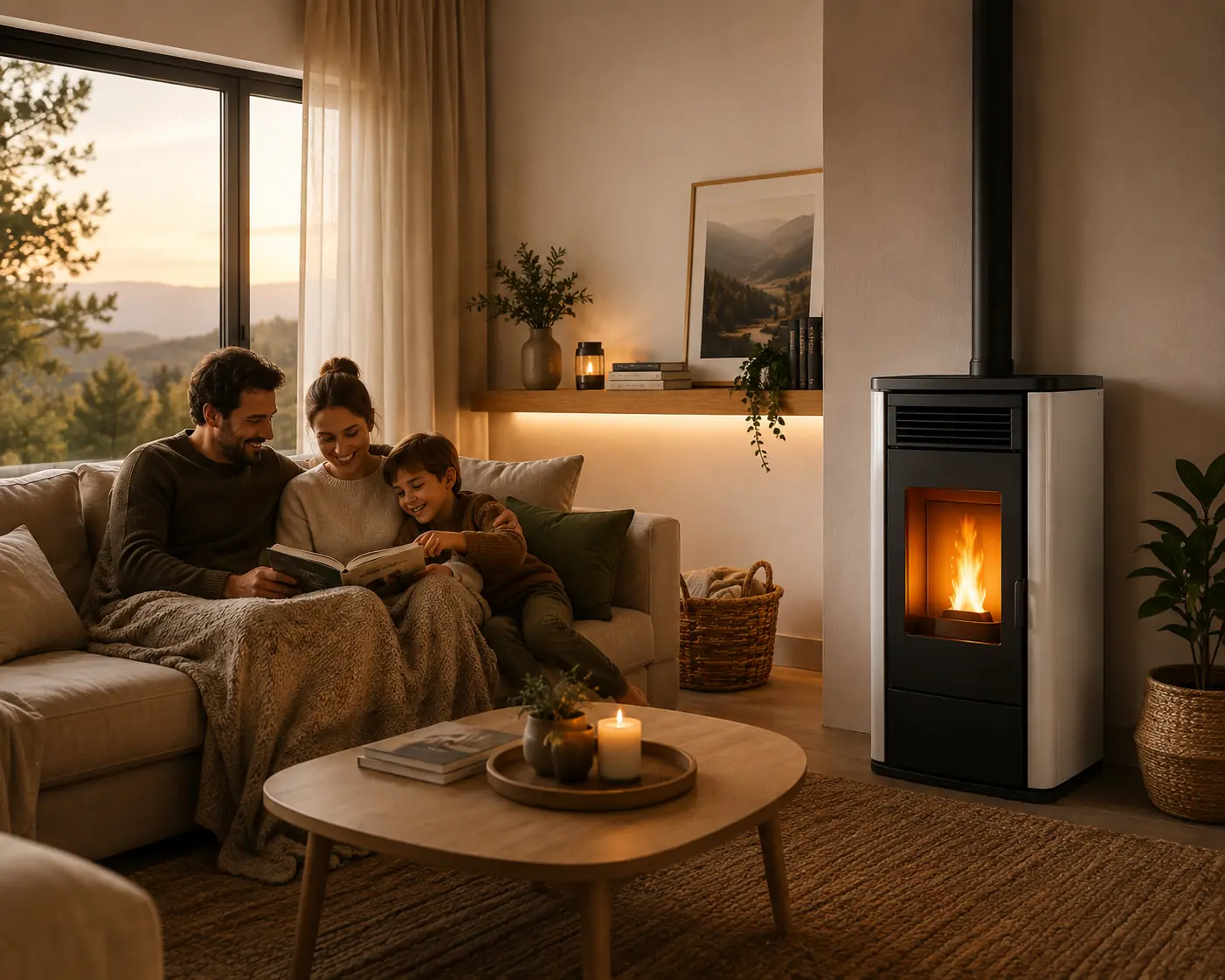
Pellet stoves burn pellets, a fuel made from compressed sawdust, in a combustion chamber that distributes heat through natural or forced convection using a small fan. They are the most common option for heating a single room or a small home, as installation is straightforward, requiring little more than a flue, and their purchase price is affordable compared with a boiler. Maintenance mainly involves emptying the ash pan and cleaning the glass regularly, and their efficiency usually exceeds 85% to 90%, meaning they make use of the vast majority of the energy contained in the fuel.
Pellet boilers
Pellet boilers operate on the same principle as pellet stoves, but instead of heating the air in a room, they heat water that circulates through radiators or underfloor heating throughout the home, just as a gas or oil boiler would. They incorporate a storage tank or silo that automatically feeds the boiler for days or weeks without manual intervention. This makes them particularly convenient for anyone looking to completely replace an oil heating system without giving up the convenience of simply adjusting a thermostat and letting the system do the rest. The initial investment is considerably higher than for a stove, but a pellet boiler can heat the entire house and, in most models, also produce domestic hot water.
Biomass stoves and boilers
The term biomass covers a broader range of solid fuels of organic origin. In addition to pellets, it includes traditional firewood, wood chips and olive stones, which are particularly common in olive oil producing regions. Biomass stoves and boilers that accept several of these fuels offer greater flexibility when purchasing fuel, as users can take advantage of whichever option is most competitively priced at the time, or even use their own fuel in the case of rural properties with access to firewood. In return, they require slightly more frequent maintenance than systems designed exclusively for pellets, as fuels such as firewood and olive stones produce more ash and require the combustion chamber to be cleaned more regularly.
Air source heat pumps
Unlike the previous systems, air source heat pumps do not burn any fuel. A heat pump extracts thermal energy already present in the outside air, even at low temperatures, and concentrates it to heat the home through underfloor heating, low temperature radiators or fan coil units. Their main advantage is that, for every kWh of electricity consumed, they can deliver between 3 and 4 kWh of heat, thanks to an efficiency ratio known as the coefficient of performance (COP). This makes them one of the systems with the lowest cost per kWh of useful heat on the current market, especially when combined with solar panels to cover part of their electricity consumption. In addition, the same equipment can provide cooling in summer, something that no combustion heating system offers. If you want to understand in detail how these systems perform during the coldest time of the year, our article on how air source heat pumps work in winter explains their operation even at temperatures below freezing.
Cost comparison per kWh of useful heat between heating systems
To compare heating systems fairly, it is not enough to look at the price of the fuel. You need to calculate the actual cost of the heat that reaches the home, taking into account the efficiency of each system. The following table provides an approximate estimate of the cost per kWh of useful heat for each system, calculated using current average fuel prices and the typical efficiency of equipment available on the market.
| System | Approximate cost per kWh of useful heat | Note |
| Air source heat pump | €0.05 to €0.07 | Electricity consumption multiplied by the equipment’s COP (3 to 4 on average) |
| Pellets | €0.06 to €0.08 | Very stable price, relatively unaffected by energy crises |
| Natural gas | €0.07 to €0.09 | Depends on the contracted tariff and fixed charges |
| Heating oil | €0.09 to €0.11 | Linked to international oil prices |
| Direct electric heating (radiators) | €0.20 or more | No multiplying effect, electricity is converted into heat at a 1:1 ratio |
As the table shows, air source heat pumps and pellets have very similar costs, both considerably lower than heating oil or direct electric heating. However, air source heat pumps tend to come out ahead when combined with solar self consumption, as a large proportion of the electricity they require can be generated on the property’s own roof without any variable energy cost. Pellets, meanwhile, stand out for their historically stable price, which is less exposed to the sudden increases experienced by gas or heating oil during periods of instability in international energy markets.
The final decision does not depend solely on the cost per kWh, but also on the initial investment, the space available for fuel storage and the desired level of convenience. Anyone who does not want to deal with loading bags of fuel or cleaning ashes will find an almost maintenance free solution in air source heat pumps. On the other hand, those who prioritise a lower initial investment and do not mind manual maintenance may find pellets an equally economical option for everyday use.
How to heat your home without spending a lot of money
Beyond choosing which heating system to install, there are several measures that can reduce heating costs regardless of the equipment you have at home:
- Improve insulation before increasing heating power. A poorly insulated home loses the heat generated almost as quickly as it is produced, so investing in insulating windows and doors often provides greater savings than changing the heating system.
- Divide your home into heating zones. You do not need to heat the entire house to the same temperature all day. Closing doors to rooms that are rarely used and lowering the thermostat at night reduces consumption without sacrificing comfort where it is actually needed.
- Take advantage of cheaper electricity periods if your system is electric. With equipment such as air source heat pumps, programming operation during periods when electricity prices are lower reduces costs without affecting the level of comfort.
- Use curtains and draught excluders. A draught excluder at the bottom of a door or a thick curtain over an old window reduces cold draughts that force the heating system to work harder.
If your home also has an electricity supply from renewable sources, the savings can be noticeable across the rest of your electricity bill, not just heating. You can explore our green energy for homes if you also want to review this aspect of your energy costs.
How to heat a very cold house
When a home is difficult to heat even with the heating system running at maximum power, the problem is almost never the equipment itself, but what are known as thermal bridges. These are areas of the building envelope, such as old windows, uninsulated roller shutter boxes and walls without cavity insulation, through which heat continuously escapes. In these cases, increasing the heating power is only a short term solution, as costs rise without a proportional improvement in comfort.
The solution is to address the building envelope first, through façade insulation, window replacement or at least improving the seals around the windows. Only afterwards should the heating system be sized according to the new, much lower level of heat loss. Combining two systems can also help in very cold homes. A pellet or biomass stove providing occasional additional heat in the most frequently used area, alongside a main system such as an air source heat pump that maintains a stable temperature throughout the house, often delivers better results than relying entirely on a single oversized system. If your home forms part of a residential community or a larger building, our article on green buildings explains how the building envelope and the energy efficiency of the building itself affect the heating costs of each individual property.


