
Are you looking for a new apartment? Not sure if you should install an aerothermal system or other heating solutions? Don’t worry, here we’ll explore a bit about what aerothermal energy is, how it works, and how much you can save with it. Let’s dive into one of the best alternatives in the climate control sector.
What is Aerothermal Energy?
Aerothermal energy is one of the latest, and quite revolutionary, technologies in the field of climate control and hot water supply for homes and buildings. It’s based on the principle of mainly harnessing the thermal energy present in the air to generate heat or cold (almost 80% of the energy comes from the ambient air), depending on the user’s needs.
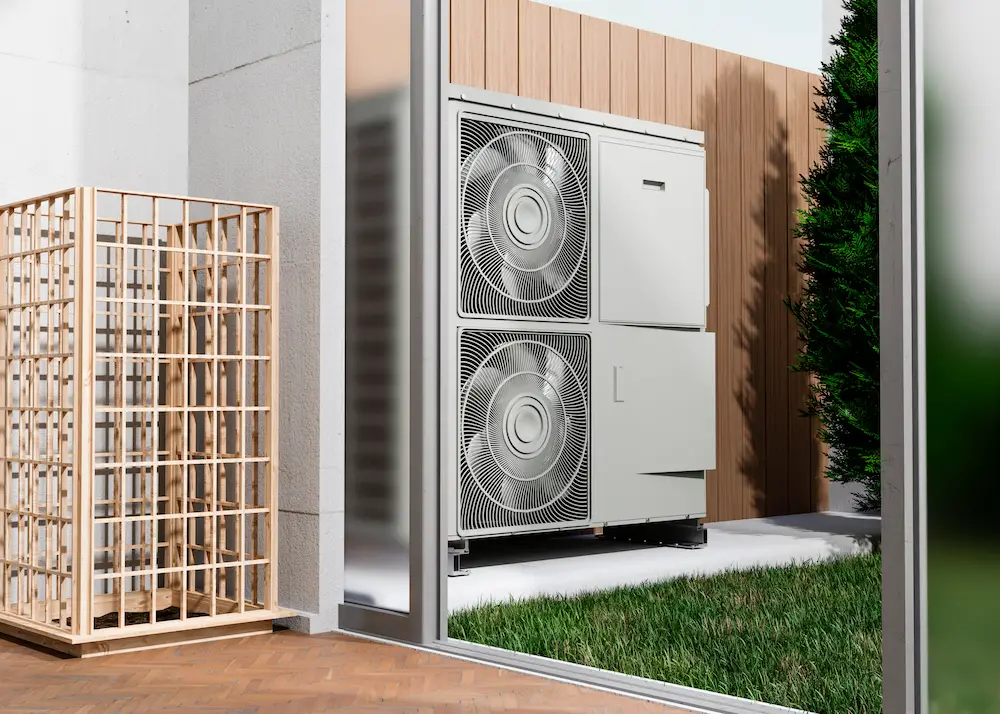
This system is primarily composed of an outdoor unit that captures the air from the surroundings, a compressor that increases its temperature, and a heat exchanger that transfers this energy to the home’s distribution system. Unlike other heating systems, it uses a renewable energy source: the AIR. It’s a growing option because it’s not only eco-friendly but also performs as well as, or better than, traditional heating systems.
How Does Aerothermal Energy Work in a Home?
What is aerothermal energy, and how does it work? It might seem complicated, but if we break it down step by step, it becomes easier to understand. It’s a system that harnesses the thermal energy contained in outdoor air to heat, cool the house, or even provide hot water.
- Capturing Outdoor Air: The process starts with the aerothermal system’s outdoor unit, equipped with a fan that draws in air from the surroundings. This air contains thermal energy (whether heat or cold), even at very low temperatures, making it uniquely suited for saving on costs.
- Air Compression: Once the air is captured, it goes through a compressor that increases its temperature. This compressor works similarly to a refrigerator but in reverse. Instead of cooling the air, it compresses and heats it.
- Heat Transfer: The compressed, heated air passes through a heat exchanger, where it transfers its thermal energy to a refrigerant circulating in a closed circuit. This heat exchange raises the refrigerant’s temperature, which is then used to heat the home’s distribution system.
- Heat Distribution: Essentially, this heat is distributed throughout your home, whether through radiators, underfloor heating, or similar systems that help to evenly distribute warmth.
- Hot Water: In addition to heating, aerothermal energy also functions as a boiler, as it can heat water. This is done via an additional heat exchanger that transfers heat from the refrigerant to the water, providing a constant supply of hot water for showers or other domestic uses.
How Does Aerothermal Energy Cool?
Cooling with aerothermal energy works similarly to the heating process: When used to cool a home, the aerothermal system reverses its thermodynamic cycle compared to the heating mode. Instead of extracting heat from outdoor air to warm the interior, aerothermal energy absorbs excess heat from inside the house and releases it into the outside air.
Aerothermal systems can reverse their thermodynamic cycle to provide both heating and cooling. This is achieved by incorporating a reversing or four-way valve in the circuit, which changes the direction of the refrigerant flow and, thus, the heat flow. In cooling mode, the reversing valve directs the heat absorbed from the inside of the home to the outside. With this:
- The warm air passes through cold water filters.
- The air temperature changes, having “removed” the warm air from your home.
- The air exits again, this time cooled, effectively cooling your home.
Do you need aerothermal energy at home?
How Much Can You Save with Aerothermal Energy?
One of the most common questions when considering installing an aerothermal system in a home is how much you can save on energy bills, or whether it really helps you save.
The reality is that you can save significantly with aerothermal energy. Extracting ambient energy from the air is FREE; you only pay for the electricity you consume. We can compare it to other sources, like natural gas or others:
- Aerothermal vs. Natural Gas: savings of between 20% and 30%.
- Aerothermal vs. Other Electric Systems: on average, between 70% and 77%.
- Aerothermal vs. Diesel Heating: savings of between 40% and 60%. The same applies to biomass.
Aerothermal energy is known for its high energy efficiency compared to conventional heating and cooling systems. By using a renewable, free energy source like air instead of relying on fossil fuels, aerothermal energy can significantly reduce a household’s energy consumption.
Additionally, with these systems, you should always consider the ratio between delivered power and consumed power. The higher this ratio, the more you’ll save with aerothermal energy. In this case, it often provides about 4 times more energy than you consume. However, keep in mind that living in a colder or hotter area does not necessarily mean you save less or more by using more heating.
What’s Needed to Install Aerothermal Energy?
Not much is needed, but a few key factors should be considered. The first is quite obvious, but ensuring you have enough space is essential. Also, if you don’t live in a single-family home, you need permission from the neighbourhood association.
- Preliminary study (as we mentioned, get permission and check if there’s enough space) and decide where you want to place both the outdoor and indoor units.
- Choose your installation professionals for your aerothermal system.
- System installation.
- Verify that everything is in order. Safety checks to make sure it’s working properly.
Contact us if you want to install aerothermal energy in your home!
Advantages and Disadvantages of Aerothermal Energy
Advantages of Aerothermal Energy
Let’s look at everything you can gain if you choose this system.
- It’s a sustainable and very clean energy source, with almost no carbon dioxide emissions. It’s a very safe system.
- Very high performance. For 1 kW consumed, you receive triple or even more. Why? Because the energy is sourced from the air, so you take that for no cost at all. Plus, with aerothermal energy, you can save up to 80% compared to traditional systems (e.g., a boiler).
- Low energy consumption.
- Quick payback on your initial investment.
- Aerothermal energy is ideal when paired with a photovoltaic installation. You might be interested in: Connected or Isolated Photovoltaic Installation?
- It’s a three-in-one system: not only does it work as air conditioning, but also as heating, cooling, and even to heat your pool.
- It takes up minimal space. Additionally, there are outdoor units available.
- You may have subsidies to install aerothermal energy.
Disadvantages of Aerothermal Energy
- Although it still functions, its performance is somewhat lower in extreme climates since it depends on the outdoor temperature.
- It pays off quickly, but it requires a high initial investment.
- You may need to increase your contracted power. We’ll get to that now.
- Without maintenance, it can be a noisy system, especially the outdoor unit.
What Power Should You Contract with Aerothermal Energy?
It depends! Generally, an aerothermal heat pump requires a power range of 3 to 4 kW, though it can go up to 20 kW. As we said, it depends on the system you’ll install in your home.
On the other hand, remember that this isn’t the only appliance in your home consuming energy. Our recommendation is to add the power you need for your aerothermal system (3, 4, 10…) to that of your main appliances, like your refrigerator, stovetop, oven… For example, you might need 0.3 kW for your refrigerator, 2 for the washing machine, 2 for the stovetop, 4 for the aerothermal system… and so on with all your daily-use appliances.
In this example, the power to contract would be 8.3 kW, although it’s always better to contract a bit more just in case. You should also consider the size of your home; a 60 m² home requires different power than a 150 m² home.
Our recommendation is always to consult with the manufacturer or your aerothermal installer. If you’re unsure about installing your aerothermal system, feel free to contact us.


