
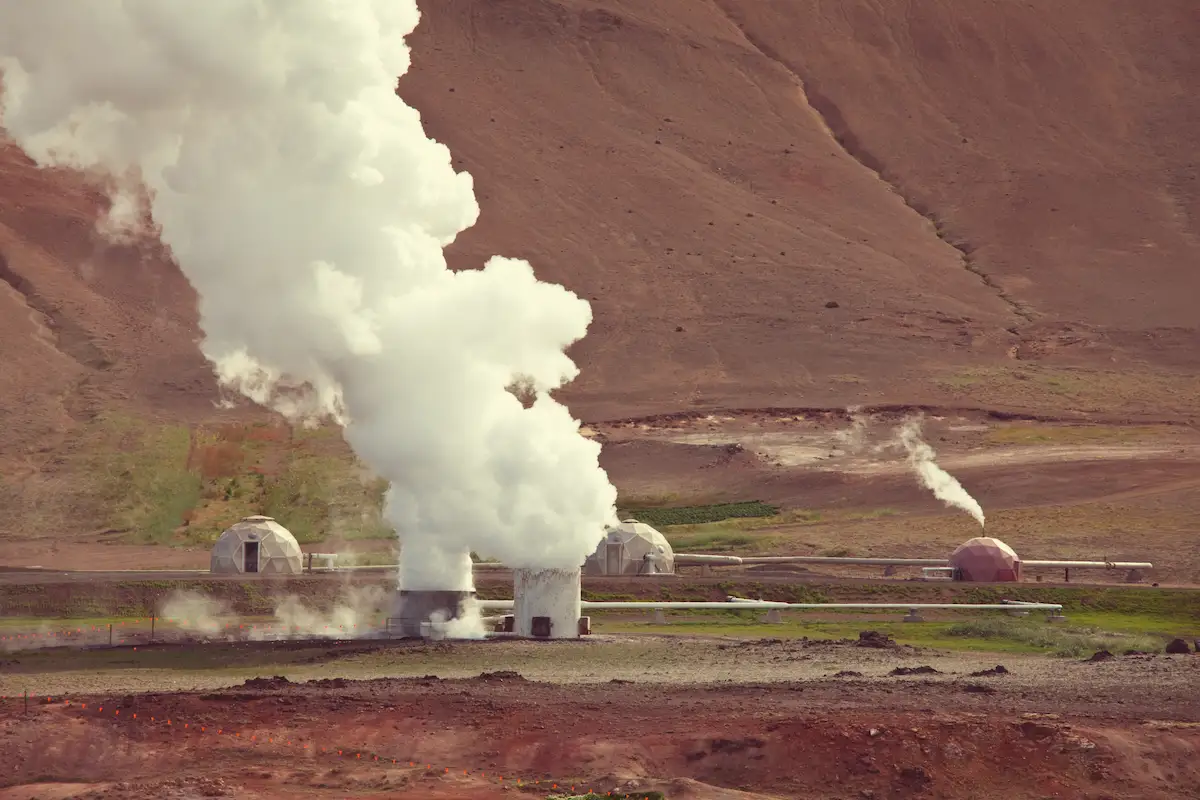
If you’re wondering whether to use this energy for domestic or industrial purposes, the first thing you should know is what geothermal energy is—so let’s get started!
Geothermal energy is a renewable energy source that is harnessed by utilizing the Earth’s internal heat to produce hot water, electricity, and more. Unlike other renewable energy sources such as solar or wind, geothermal energy is available continuously, regardless of weather conditions or day-night cycles.
As an interesting fact, the name comes from the Greek words geo and thermos, meaning earth and heat. The name itself suggests that this energy comes from the Earth’s heat, and if properly harnessed, it is an inexhaustible source.
Moreover, there are several types of geothermal energy:
- High-temperature geothermal: With temperatures above 150ºC, found in the most active areas of the Earth’s crust. Significant heat can be extracted from water vapor.
- Medium-temperature geothermal: Just below high temperature but still above 100ºC.
- Low-temperature geothermal: With temperatures above 30ºC.
- Very low-temperature geothermal: Located close to the surface, with temperatures typically between 15 and 30ºC.
Where Does Geothermal Energy Come From?
Geothermal energy comes from the heat generated in the Earth’s core. This heat is produced by the decay of radioactive elements such as uranium, thorium, and potassium, as well as residual heat from the planet’s formation about 4.5 billion years ago. Temperature increases as you go deeper toward the Earth’s core, reaching thousands of degrees Celsius.
Heat is transferred from the core to the surface through three main processes: conduction, convection, and radiation. Conduction happens when heat moves through solid materials like rocks and minerals. Convection happens when heat travels through fluids like water and magma, and radiation refers to heat transfer through empty space.
The most productive geothermal areas are located in regions with volcanic and tectonic activity, where magma is closer to the Earth’s surface, such as the Pacific Ring of Fire and other geothermally active regions.
Main Uses of Geothermal Energy
Geothermal energy has a wide range of applications. For example, it is used to generate electricity. Geothermal power plants use steam or hot water extracted from geothermal reservoirs to turn turbines that generate electricity. This process can be direct, using dry steam or flash steam, or indirect, with a secondary fluid in binary-cycle plants.
Another use is heating and cooling. Geothermal energy is used for heating buildings and providing hot water. Geothermal heating systems, also known as geothermal heat pumps, extract heat from the ground during winter and transfer it into buildings. In summer, the process is reversed to provide cooling.
Lastly, geothermal energy also has industrial and agricultural applications. It is used in industrial processes that require heat, such as drying agricultural products, pasteurizing dairy products, desalinating water, and heating greenhouses.
Additionally, these applications are usually categorized by the type and temperature of geothermal energy:
- High temperature: For electricity generation.
- Medium temperature: Thermal applications, such as heating systems or sanitary hot water.
- Low temperature: For industrial and agricultural use.
- Very low temperature: For “leisure” purposes, such as spas. It can also be used in heat pumps.
Is Geothermal Energy Clean or dirty?
Geothermal energy is considered a clean and sustainable energy source, as it produces low greenhouse gas emissions compared to fossil fuels and other renewable sources.
How Does a Geothermal Power Plant Work?
Geothermal power plants operate by extracting steam or hot water from the subsurface. Depending on the temperature and pressure of the geothermal resource, different technologies can be used:
- Dry steam plants: Use steam directly from the geothermal reservoir to drive turbines and generate electricity. These plants are found in areas with high-temperature geothermal resources.
- Flash steam plants: Extract hot water at high pressure from the geothermal reservoir. By reducing the pressure, some of the water turns into steam, which is used to drive the turbines. Flash steam plants are suitable for intermediate- to high-temperature geothermal resources.
- Binary-cycle plants: Use a secondary fluid with a lower boiling point than water. Heat from geothermal water is transferred to the secondary fluid, which vaporizes and drives the turbines. These plants are suitable for low- to intermediate-temperature geothermal resources.
Now that we’ve seen the technologies that can be used to produce geothermal energy, let’s look at the general process of how one of these plants works:
- The plant extracts a mix of water and steam through a well. This mixture reaches a cyclone separator, which separates steam from the water.
- The water in liquid form is reinjected to be reheated.
- The steam turns the turbine, activating the power generator, which converts mechanical energy into electricity.
- The generated electricity is sent to substations, which distribute it through a power grid.
- After all leftover condensed steam is reinjected underground, the process repeats.
Pros and cons
Advantages of Geothermal Energy
What advantages can this renewable source offer? Quite a few! Here are the main ones:
- Less reliance on fossil fuels, reducing the carbon footprint of power plants dedicated to energy production.
- Far fewer waste products and harmful gases are generated, reducing environmental impact and protecting the environment for a sustainable future.
- Of course, it is a clean energy source.
- Versatility. In addition to electricity generation, geothermal energy can be used for heating, cooling, and various industrial processes.
Disadvantages of Geothermal Energy
This type of renewable, clean energy typically has few disadvantages. That said, its main drawback is that it requires very specific geological conditions for effective installation. Some may think noise is a disadvantage, but this is not the case since, once energy production starts, the noise disappears.
Another potential disadvantage is that it can contaminate nearby water sources with chemical compounds such as ammonia or arsenic.


