
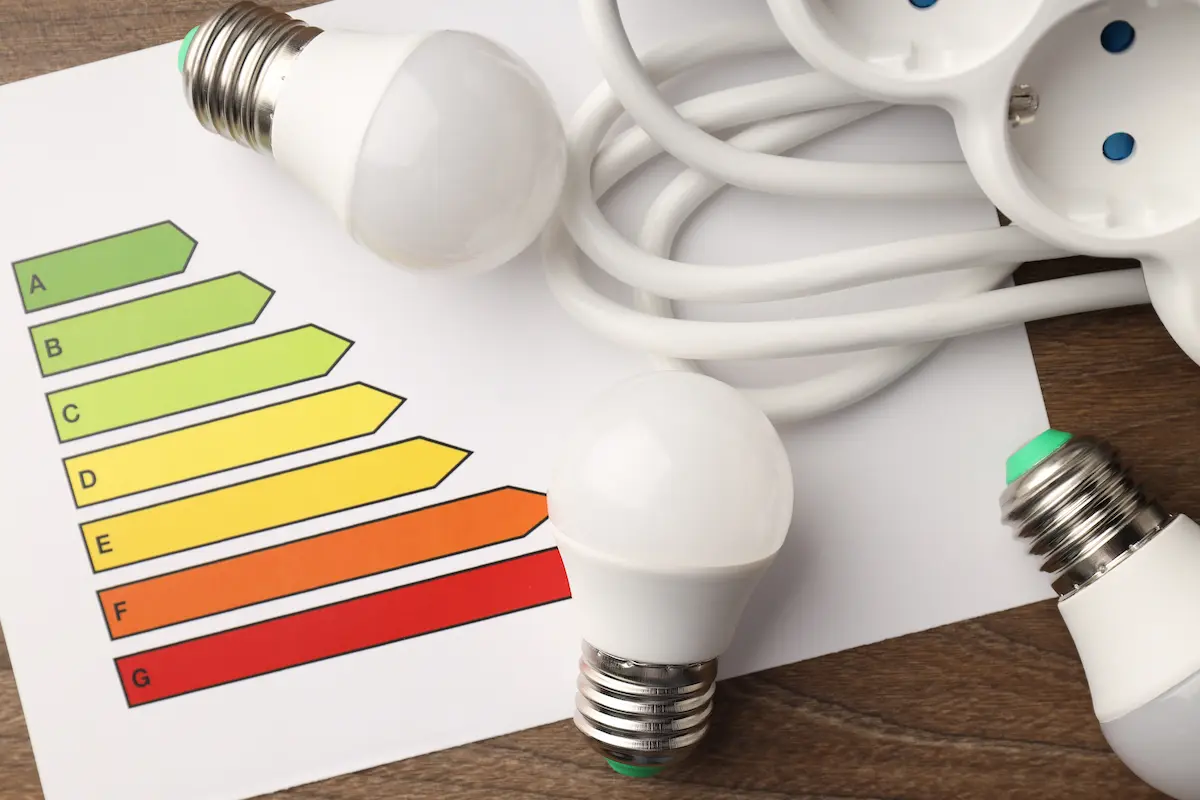
Did you know that appliances account for an average of 30-50% of a household’s energy consumption? Knowing how much each appliance consumes helps you to reduce your bill, and also to make more environmentally responsible decisions. We’re going to tell you all about the energy consumption of household appliances, how the efficiency label influences them and whether it’s really worth investing in energy-efficient models such as A+++. Let’s get to it.
Most energy-consuming household appliances
Of course, some consume more than others. The 5 appliances that consume the most in descending order are: dryer, dishwasher, refrigerator, washing machine and television. Let’s see why:
- The tumble dryer is one of the most voracious devices, it generates heat and is often used in long cycles. An A++ dryer can consume between 1.5 and 2.5 kWh per use, depending on the load and type of drying. If you use it frequently, the impact is noticeable. On average, a normal dryer consumes 32 kWh per month.
- The dishwasher, although efficient if used properly, also consumes quite a lot, an average of 22.71 kWh per month.
- The refrigerator, even without generating heat, also has to be in constant operation, consuming on average 20.25 kWh per month.
- The washing machine, consuming an average of 16.54 kWh per month.
- Television, with an average of 10.32 kWh per month.
What is the consumption of a class E refrigerator?
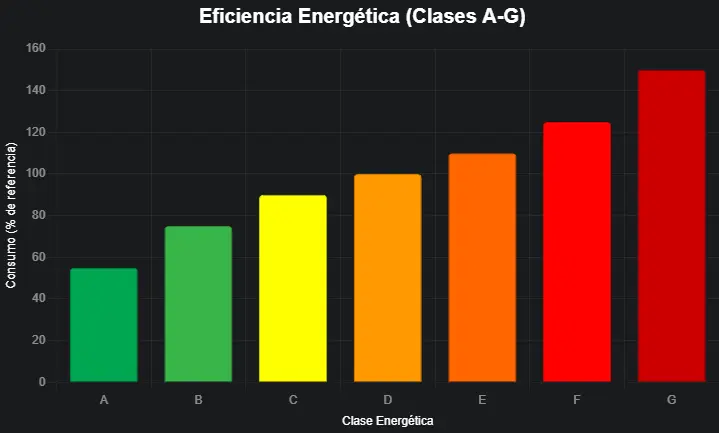
To talk about a specific appliance, let’s analyze the refrigerator. Since the new energy labeling came into force in the EU, they have been reclassified, going from label A to G. As you can imagine, a class E refrigerator has a rather low energy efficiency. In fact, a typical class E refrigerator can consume between 230 and 280 kWh per year, depending on the model, the useful volume, the number of doors, and whether or not it includes a freezer.
Translating it into euros and with an average price of 0.20 €/kWh, we are talking about 46 to 56 € per year. Not that it is exorbitant, but it is quite a lot compared to other models. We also leave below a graph for you to see the energy labeling and how consumption varies from A to G.
Consumption of a class A refrigerator
The most efficient refrigerators currently on the market are rated A, the highest under the new regulations. A class A refrigerator can consume around 100 to 120 kWh per year, i.e., less than half that of a class E. In economic terms, this represents a cost of between €20 and €25 per year.
Does the difference seem small? Think about the fact that the refrigerator will be with you for more than 10 years. That means a saving of between 200 and 300 euros over its lifetime, simply by choosing a more efficient model.
What about an A+++ refrigerator?
The truth is that they are no longer marketed under that label since 2021 but many older models still retain it in their specifications. An A+++ refrigerator could cost around 150 kWh/year or even less, which was equivalent to about €30 per year.
These types of models used to represent the higher end of the range before the regulatory change. If you still have one at home or see a good deal, they are still a very efficient option.
How to calculate the consumption of a household appliance
Knowing how much an appliance consumes is easier than it seems, you only need this formula: Consumption (kWh/year) = Power (kW) x Hours of use per day x Days per year. This calculation will be very useful to see if it is worthwhile to change the appliance or not. However, many manufacturers already include this estimate in the energy label, although you can also check it in their technical data sheet. To give a practical example if you want to calculate it:
- An A++ dryer with an average power of 2 kW, used 3 times a week (about 1.5 h each time).
- Total hours per year: 3 uses x 1.5 h x 52 weeks = 234 hours
- Annual consumption: 2 kW x 234 h = 468 kWh/year
- In euros: 468 x 0,20 € = 93,60 € per year
Our tips to reduce your energy consumption
In addition to changing your appliance if it has a label below B, we also recommend that you try small changes in your consumption habits, because they can already make a huge difference in your daily expenses.
- Defrost the refrigerator when it is low, because excess ice forces the motor to work harder.
- Do not open the refrigerator door unnecessarily. Every time you do, hot air enters and the motor is activated.
- Use eco programs in dishwashers and washing machines whenever possible.
- Always fill appliances before starting them up: washing machine, dishwasher…
- Air dry when you can. The dryer is useful, but if you can hang outdoors or in well-ventilated interiors, you will greatly reduce consumption.
- Watch out for stand-by. Use power strips with switches to completely turn off appliances you don’t use every day.
- Clean filters and air outlets, since a clean appliance consumes less energy.
- It is important to look at the energy labeling before buying. Look not only at the letter, but also at the exact consumption in kWh/year.
Are A+++ appliances worth it?
The answer is YES. Let’s remember that these no longer exist, but their equivalent, which is label A and B at the most. They are more expensive than those with a lower labeling, but they consume much less, so in the medium term, they are already more profitable.
They also have other advantages, such as being quieter, usually have more modern technologies such as intelligent sensors or inverter motors, and have much better optimized cycles and longer service life.
Even so, BEWARE, don’t just buy for the label, you also have to consider how much you use the appliance. If you have a second refrigerator that you hardly use, it is not worth spending more for a super efficient model. On the other hand, if we are talking about the main refrigerator or the family washing machine that you use every day, the savings are important. To summarize, we leave you this table.
| Energy class | Approx. annual consumption | Estimated cost €/year | Is it worth it? |
|---|---|---|---|
| E-Class | 230 – 280 kWh | 46 – 56 € | Only if you have no other option |
| Class A+++ (no longer exists, equivalent to B) | 100 – 150 kWh | 30 – 35 € | Yes, if used daily |
| Class A | 100 – 120 kWh | 20 – 25 € | High efficiency and technology |
As you can see, knowing the energy consumption of your appliances is key to reducing your electricity bill. Remember that a change of habits, no matter how small it may seem, can make a difference. And if you are thinking of renewing any of your appliances, don’t just look at the purchase price, look at their lifetime consumption.


