
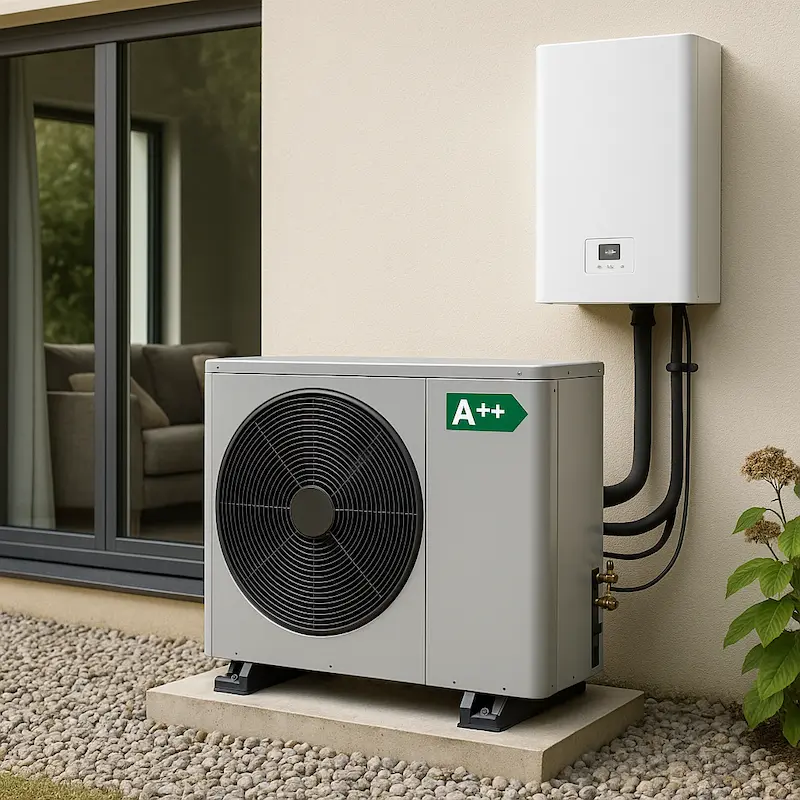
Aerothermal energy is not only used to heat the house in winter. In summer, this system can also help you maintain a comfortable temperature in your home without your electricity bill skyrocketing. Do you want to know how aerothermal energy works in summer? In this complete guide we explain it step by step, although, if you want more information, we recommend you to read this post about what aerothermal energy is and how it works.
The main objective will be to save energy in summer with aerothermics
One of the main reasons why more and more people are opting for aerothermal energy is its energy efficiency. Instead of generating cold from pure electricity as it does an air conditioning of all life, the aerotermia takes advantage of the energy of the outside air to air condition your home.
During the summer, this system acts as a reversible heat pump: it extracts heat from inside the house and expels it to the outside, thus cooling the indoor environment with a much lower consumption. Basically:
- You reduce your electric bill significantly.
- You have a much lower environmental impact.
- You have greater thermal comfort in any room.
- It is an ideal solution for hot climates or intense summers, as it allows keeping the house cool without the need to install independent cooling systems.
How aerothermal energy works in summer
Step-by-step operation
The aerothermal system is composed of an outdoor unit (similar to an air conditioner), a heat pump and an internal distribution system such as radiant floor cooling, fan coils or splits. When you use it in summer to cool your house, it works like this:
- The outdoor unit captures the ambient air, even if it is warm.
- Interior heat extraction. Thanks to a thermodynamic cycle with refrigerant, the system transfers heat from the inside of the house to the outside.
- Distribution of cool air. The internal system (any of the 3 internal distribution modes) distributes the cool air throughout the rooms.
- Temperature maintenance. The heat pump modulates its power to maintain the desired temperature stable, without ups and downs.
Cold distribution modes
The 3 modes mentioned above:
- Cooling radiant floor, which emits cold in a soft and uniform way. The best for you if you want good comfort and are bothered by drafts at home, even if they are mild.
- Fan coils, the modern radiators that expel cold air. Faster in lowering the temperature.
- Splits or ducts. If your house has a false ceiling it is perfect because it helps you to channel the cold air in a very discreet and efficient way.
Benefits of aerothermal energy in summer
Betting on an aerothermal system in summer has many advantages, whether you already use it for heating or if you are considering installing it:
- High energy efficiency: Power consumption is much lower than that of a traditional air conditioner.
- Integral air conditioning. A single system serves to heat in winter and cool in summer.
- Renewable energy. Uses energy from the air, free and sustainable.
- Greater comfort. It allows to maintain a constant temperature without sudden changes or annoying cold currents.
- Reduced emissions. By not relying on fossil fuels, it reduces the carbon footprint.
- Possibility of combining with solar energy. Even more savings if complemented with photovoltaic panels.
- Quieter than other air conditioning systems.
- It can help you dehumidify your home if you have a problem with humidity.
- Lower maintenance than other conventional air conditioning systems.
Are there any disadvantages?
Virtually none. The only thing you have to take into account is that the initial investment, as is normal, will be somewhat higher than an air conditioner, but then it pays off quite well over time. Then, in areas with high humidity, condensation problems may appear (which we will see later). You also need space for the outdoor unit and, depending on the system, for underfloor heating or fan coils.
Even with these considerations, the cost-benefit ratio is very positive if you are looking for efficiency and sustainability.
At what temperature should the fan heater be set in summer?

Ideally, you should simply maintain a good balance between comfort and efficiency. The general recommendation is to keep the temperature in your home between 24ºC and 26ºC. Lower temperatures mean higher energy consumption without a noticeable increase in comfort, as well as favoring the appearance of condensation.
It is also advisable to avoid setting the fan heater at very low temperatures (such as 19ºC or 20ºC), as this causes the system to work at its maximum, increasing consumption. You can use time programmers or home automation to adapt the operation to the hottest hours. Close blinds and curtains in the central hours of the day to improve system performance.
Does the fan heater always have to be left on?
It is not necessary to leave the fan heater on 24 hours a day, but it is not recommended to turn it on and off constantly, since it is designed to maintain the temperature with a stable consumption. If you turn it on and off constantly, it could consume more energy at start-ups and affect the performance of the system. The best option depends a lot on what you do on a daily basis. Our advice for these two modes is:
- If you decide to leave it on constantly, keep it at a reasonable temperature (24-26ºC), with minimum peaks of work.
- If you want to program it by hours, simply activate it during the hours when you are at home, and reduce it at times when there is no one in the house.
Can there be condensation in summer with aerothermics?
Yes, especially if you use cooling floors or if the cooling water temperature is too low. Condensation occurs when a cold surface comes in contact with moist air. In aerothermal systems in summer, it can happen if:
- The cooling water temperature is lower than the ambient dew point.
- There is poor ventilation in the dwelling.
- Indoor humidity is not well regulated.
How to avoid condensation?
Don’t worry, it is easy to avoid this, simply adjust the water in the cooling soil to temperatures above 18ºC. Also, to control the relative humidity a bit (which should be between 45 and 60), you can use a hygrometer. Of course, you should ventilate at least 5-10 minutes every day, this will help a lot and, if you already have some humidity, you can implement a dehumidification system.
Conclusion on aerothermal energy in summer
In conclusion, if you were wondering how aerothermal energy works in summer, now you know that it is one of the most efficient, sustainable and comfortable ways to keep your home cool. Well configured and with an installation adapted to your needs, it can become your best ally to combat the heat without surprises in the bill. And if you have not yet taken the step, maybe this summer is the perfect time to start enjoying it.


