
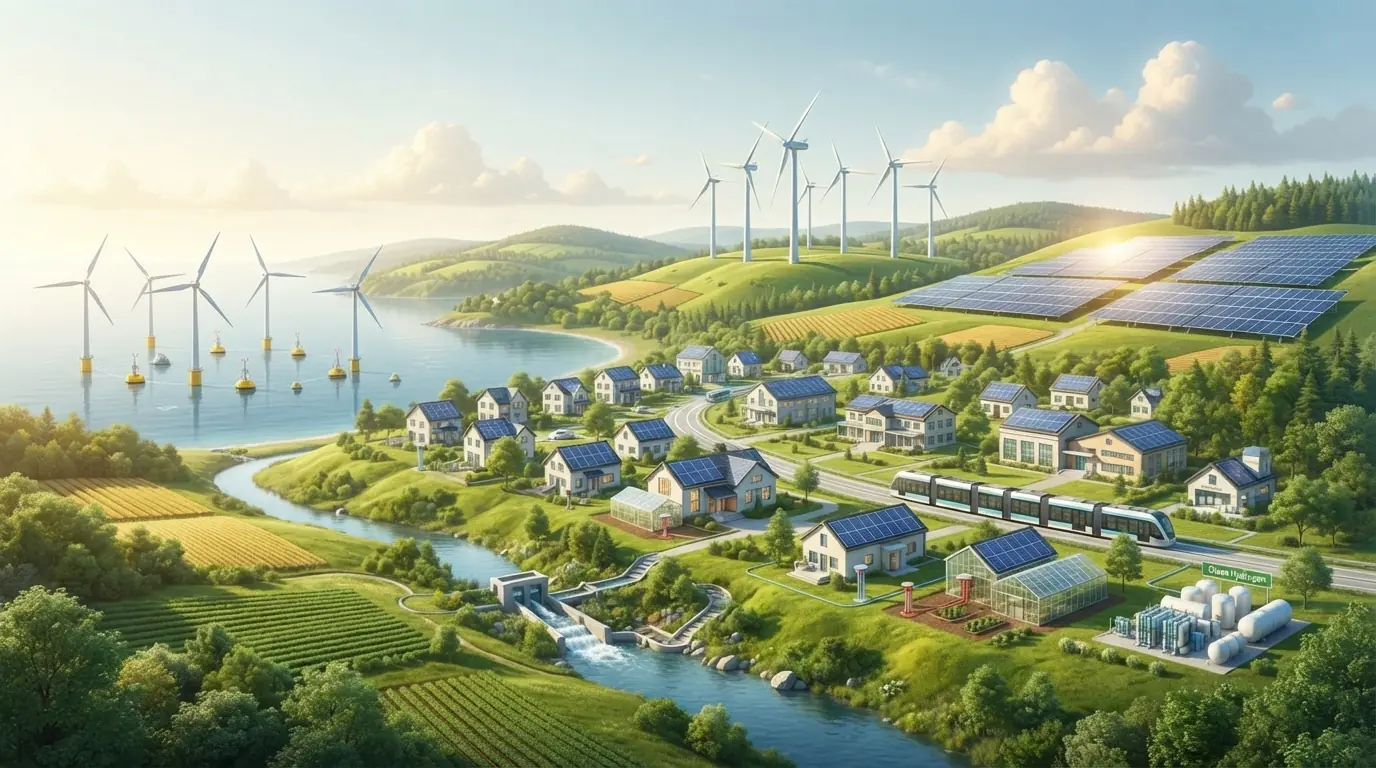
We call renewable energy any energy obtained from natural sources capable of regenerating at a rate equal to or greater than the rate at which they are consumed, unlike fossil fuels, which take millions of years to form and are depleted with every barrel or tonne extracted. The sun, wind, moving water and the Earth’s heat are examples of resources that are practically inexhaustible on a human timescale. That is why technologies capable of harnessing them, such as solar panels, wind turbines and hydroelectric dams, are grouped under the same term. In this article, we explain exactly what renewable energy is, what types exist, how it differs from clean energy and what it is used for in everyday life.
What is renewable energy and what are some examples?
Renewable energy is, by definition, energy that comes from a resource that nature continuously replenishes. The sun rises every day, the wind continues to blow and the water cycle is constantly renewed, so none of these sources is depleted simply by using them to generate electricity or heat. Among the most common examples of renewable energy are solar energy captured by photovoltaic panels on the roof of a home, wind energy generated by wind farms in particularly windy areas, hydropower produced by flowing water in hydroelectric power stations, biomass burned in boilers and pellet stoves, and geothermal energy that harnesses the stable heat of the ground to heat and cool buildings.
What distinguishes all these sources from fossil fuels is not only that they are not depleted, but also their environmental impact. Generating electricity or heat from them produces very few greenhouse gas emissions during the process, compared with burning coal, oil or natural gas, which releases large amounts of CO2 into the atmosphere. This combination of continuous availability and low environmental impact is what has made renewable energy the foundation of the energy transition in most developed countries.
What is green energy and is it the same as renewable energy?
It is worth making a distinction here that is often overlooked: renewable energy and clean or green energy are not exactly the same thing, even though these terms are often used interchangeably in everyday language.
Energy is renewable if its source does not run out, while energy is clean if its generation produces very few polluting emissions or greenhouse gases. Most renewable energy sources are also clean, but not all of them are completely emission free. Burning biomass, for example, releases CO2 during combustion, although that carbon may be considered neutral in the long term because it comes from organic matter that previously absorbed it during growth.
The opposite situation also exists. Nuclear energy generates electricity with very low direct CO2 emissions, making it a relatively clean source from that particular perspective, but it is not renewable because it depends on a finite fuel, uranium, which is depleted through use and generates radioactive waste that is difficult to manage. If you want to explore these differences in greater technical detail, our article on renewable and non renewable energy sources compares both groups and explains why this distinction matters when planning the energy transition.
Types of renewable energy available today
If we had to choose just three, the most widespread renewable energy sources with the greatest contribution to global electricity generation would be solar, wind and hydropower, as they have the most mature technologies and the largest installed capacities. However, the range is actually much broader, and understanding the five or six main types helps explain why some countries invest more heavily in certain sources than others, depending on their geography and natural resources.
Solar energy
Solar energy harnesses radiation from the sun through two main technologies: photovoltaic technology, which converts light directly into electricity using semiconductors, and solar thermal technology, which uses collectors to heat water or other fluids. It is the fastest growing source thanks to falling panel costs.
Practical example of solar energy:
A residential self consumption installation in a detached house, with rooftop panels covering daytime electricity consumption, or large photovoltaic power plants in arid areas, such as major solar farms in southern Spain, that feed large amounts of electricity into the transmission grid.
Wind energy
Wind energy converts the kinetic energy of the wind into electricity using wind turbines. It requires consistent wind conditions and is divided into land based wind farms, known as onshore wind farms, and offshore wind farms, which use large turbines anchored at sea, where the wind blows more strongly and consistently.
Practical example of solar energy:
Large wind farms located along mountain ridges in Aragon or offshore wind farms installed in the North Sea off the coasts of the United Kingdom and Denmark.
Hydropower
Hydropower is obtained from moving water, usually from water released from reservoirs that drives turbines inside a hydroelectric power station. It is one of the oldest and most stable renewable energy sources, capable of adjusting its production quickly according to demand, although its development depends on the availability of suitable rivers and reservoirs.
Practical example of hydropower:
Large dams in river basins or pumped storage power stations, which use surplus electricity to pump water back up to an upper reservoir during off peak hours and reuse it later, effectively operating like a large water battery.
Biomass
Biomass uses organic matter, such as forestry residues, agricultural waste or pellets made from sawdust, as fuel to produce heat or electricity through combustion. It is particularly important for domestic and industrial heating, and its main advantage is that it makes use of waste that would otherwise be discarded.
Practical example of biomass:
Communal biomass boilers in residential buildings or pellet stoves in detached houses that replace traditional fossil fuels by using waste from local agricultural pruning.
Geothermal energy
Geothermal energy harnesses the stable heat beneath the Earth’s surface, which remains practically constant throughout the year at depths of just a few metres. It is used both to heat and cool homes through ground source heat pumps and, in areas of high volcanic activity, to generate electricity directly.
Practical example of geothermal energy:
Geothermal district heating networks that heat entire neighbourhoods in countries such as Iceland, or residential ground source heat pumps that extract heat from the ground using vertical boreholes to supply underfloor heating.
Tidal and wave energy
These are still among the least widespread renewable energy sources, but they have considerable potential in coastal countries. Tidal energy harnesses the movement of the tides, while wave energy captures the energy of ocean waves. Both are at a less mature stage of technological development than solar or wind energy, although several pilot projects are already operating at different locations along the European coastline.
Practical example of tidal and wave energy:
Tidal power stations such as the Rance facility in France, which harnesses the large tidal range of the Atlantic to drive bidirectional turbines as water flows in and out.
Green hydrogen
Green hydrogen should also be added to this list, although it is not actually a primary energy source like the others, but an energy carrier. It is obtained by subjecting water to an electrolysis process powered by renewable electricity, allowing that energy to be stored and transported as a gas for applications where direct electrification is more difficult, such as heavy industry or long distance transport.
Practical example of green hydrogen:
Its use in heavy industries such as steelworks to reduce emissions, or to power fleets of heavy goods vehicles and long distance trains where electrification using lithium batteries is not viable.
What is renewable energy used for?
Beyond generating electricity for the main grid, renewable energy has very practical applications in everyday life. In the home, it allows households to produce their own electricity through solar self consumption, reducing their dependence on the grid and lowering electricity bills. For heating and cooling, systems such as air source heat pumps harness heat from the outside air to heat and cool the home while consuming much less electricity than conventional systems. In transport, both electric vehicle charging and, in the longer term, green hydrogen for heavy transport depend directly on the electricity powering them coming from renewable sources if emissions are to be reduced throughout the entire process.
On a broader scale, renewable energy also allows industry to reduce its carbon footprint, residential and office buildings to move towards energy self sufficiency, and countries to reduce their dependence on imported fossil fuels. This has become especially relevant in recent years because of the volatility of international energy prices.
This transition is not limited to energy generation itself, but also involves how we design and manage the spaces where we live and work. If you want to see how these principles are applied to construction and the energy management of an entire property, our article on green buildings explains what makes them more efficient and sustainable than conventional buildings.
Advantages and disadvantages of renewable energy
As with any energy infrastructure, the transition towards a model based on natural resources offers major advantages over fossil fuels, although it also presents certain technical and operational challenges worth understanding.
Main advantages
- Inexhaustible sustainability: Renewable energy comes from sources such as the sun and wind, which are not depleted through use, ensuring long term supply without compromising the resources of future generations.
- Reduction of the carbon footprint: Unlike coal or natural gas, renewable electricity generation produces very few greenhouse gas emissions, making it essential for slowing climate change.
- Direct financial savings: Renewable energy allows partial or complete independence from the electricity grid through residential and industrial self consumption, making it possible to recover the initial investment and achieve substantial savings.
Disadvantages and current challenges
- Intermittency and dependence on weather conditions: Energy production does not always coincide with peaks in demand, as it depends on unpredictable weather conditions such as cloudy days or periods without wind.
- Need for storage: To address intermittency, storage systems, such as physical or virtual batteries, or pumped storage power stations must be used, increasing the initial cost of the project.
- Land use and visual impact: Installing large solar or wind farms requires extensive areas of land, which can create landscape and environmental concerns in rural areas.
To mitigate these disadvantages, the sector is rapidly moving towards combining technologies, integrating solar and wind generation with advanced storage systems and intelligent software management. This makes it possible to balance supply and demand efficiently in real time.
Key reasons to embrace renewable energy in your everyday life
Understanding what renewable energy is, the different types available and how they are applied in everyday life demonstrates that the energy transition is no longer simply an option for the future, but a real tool for achieving savings and efficiency. Whether by installing solar panels on your roof to reduce electricity bills, optimising your home’s heating and cooling or adopting clean energy carriers in industry, harnessing nature’s inexhaustible resources allows greater independence from fossil fuels and the volatility of the energy market.
Weighing up the advantages and disadvantages of renewable energy shows that, although technical challenges such as intermittency and the need for storage still exist, today’s technological solutions, from residential self consumption to intelligent surplus energy management, make it possible to overcome these barriers effectively. Investing in these inexhaustible energy sources not only reduces the carbon footprint and optimises household finances, but also establishes a more independent, cleaner energy model that is better prepared for the future needs of any home or industry.


