
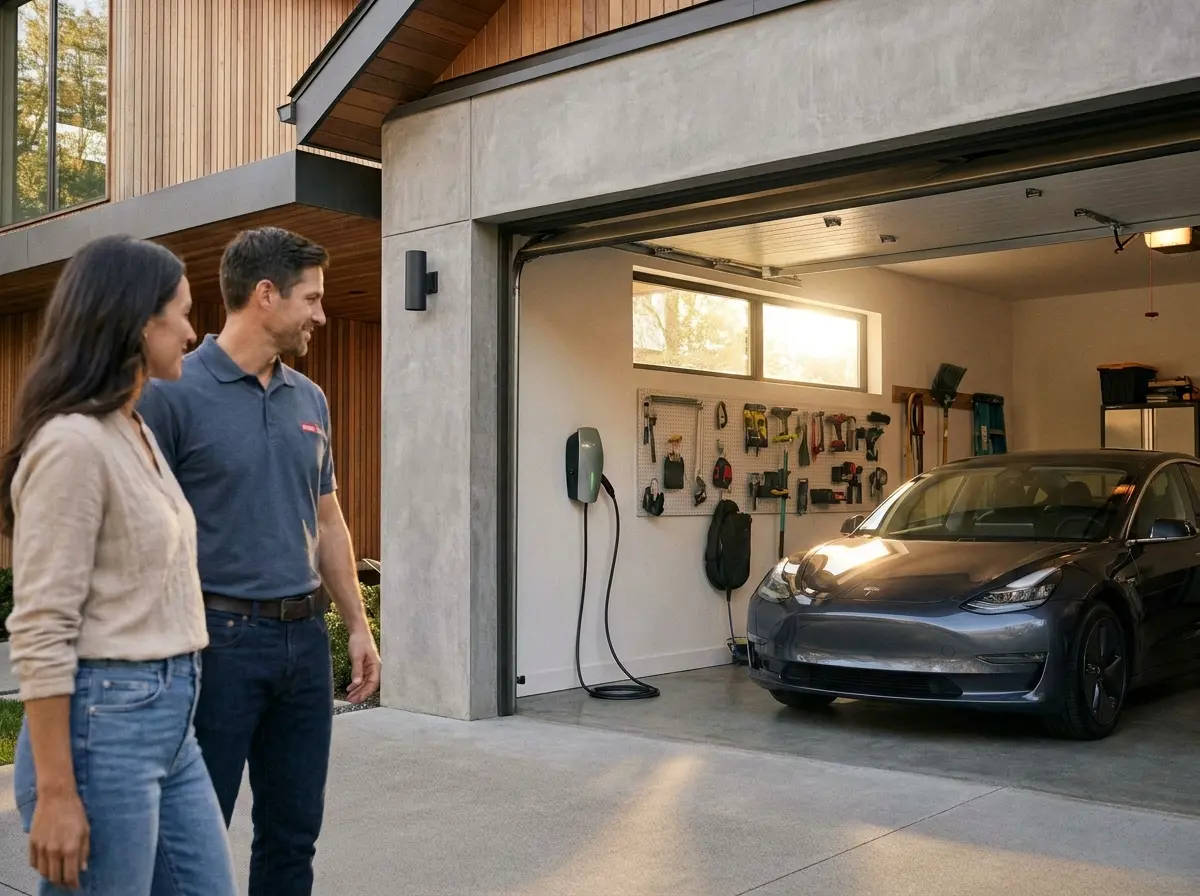
Making the switch to sustainable mobility is an excellent decision, but one of the first questions that arises concerns the practicalities of everyday charging. Knowing how to charge an electric car at home efficiently is essential for maximising financial savings, ensuring the safety of your home and enjoying maximum convenience. In this guide, we explain everything you need to know about home charging points, connector types, charging times and costs.
Why charge your electric car at home?
When considering the advantages of charging an electric car at home rather than relying exclusively on public charging infrastructure, it is important to analyse both the pros and cons of having your own installation.
As with almost everything, there are some disadvantages, but in this case the advantages far outweigh the drawbacks.
Electricity savings
Electricity prices vary according to overall demand on the grid. In addition to taking advantage of the cheapest charging hours, there are other key ways to save money:
- Off-peak tariffs: Between midnight and 08:00, electricity demand falls considerably, reducing the price per kWh. Programming your charger to operate during this period can significantly reduce the final cost.
- Solar self consumption: If you have a photovoltaic solar panel installation, you have access to a source of clean, free energy. You can use this electricity directly to charge your vehicle or take advantage of surplus solar energy.
- Reduced battery wear: By scheduling charging sessions and having an optimised installation, you avoid frequent use of direct current (DC) rapid charging, helping to protect the battery’s internal chemistry and extend its service life.
Convenience and everyday routine
Just as you charge your mobile phone every night, you can incorporate vehicle charging into your nightly routine:
- 100% battery charge every morning: You start the day with the maximum available driving range, without having to make a detour to a charging station or waste time before going to work.
- Smart management: Modern wallbox chargers allow you to monitor consumption, adjust charging power and schedule charging times conveniently through a mobile application.
- Time savings: You can forget about waiting at EV charging stations or searching for available public charging points.
Performance and practicality
With a typical 7.4 kW home charging installation, it is possible to recover between 50 and 70 km of driving range for every hour of charging. A full overnight charging session can recharge your car’s battery without rushing or overheating.
Installing an electric car charging point at home
Having an electric car charging point at home is now a much simpler and more accessible process than many people think.
- Residential buildings with communal garages: Current Spanish legislation protects users under Article 17.5 of the Horizontal Property Law. You only need to notify the president or property administrator in writing of your intention to install the charging point before work begins. Approval at a homeowners’ association meeting is not required. The only requirement is to hire an authorised installer and run the electrical supply from your home’s individual electricity meter.
- Detached houses: In this case, the process is straightforward, as no prior notification to third parties is required. You simply need a suitable electrical distribution board and a qualified technician to carry out the installation, allowing you to charge your electric car at home with complete peace of mind regarding safety.
Types of electric car charging connectors
When thinking about electrical connectors, traditional household plugs usually come to mind. However, electric vehicle charging requires specific standards capable of handling higher power levels and communication protocols.
Similar to the different types of electrical sockets encountered when travelling to other countries, the types of electric car charging connectors vary depending on the power required, geographical region and type of current, whether alternating or direct:
Schuko connector (conventional household socket)
- This is the standard domestic electrical socket.
- It only allows slow charging, at approximately 2.3 kW.
- It can be used as an emergency solution, but it is not recommended for regular charging because continuous operation at high current can cause the electrical circuit to overheat.
Type 2 or Mennekes connector (European standard)
- It is the official European standard for alternating current (AC) charging.
- It supports both single-phase and three-phase charging, reaching up to 22 kW in private and public installations and up to 43 kW in certain cases.
- It is the standard connector found on most home chargers and public charging stations.
CCS Combo connector (rapid DC charging)
- It is the European standard for rapid and ultra-rapid charging using direct current (DC).
- It combines a Type 2 connector with two additional lower pins dedicated exclusively to high power charging.
- It supports charging power ranging from 50 kW to more than 350 kW at charging stations along major routes.
What is a wallbox?
Unlike a simple adapted electrical socket, a wallbox is a physical wall-mounted charging point (Mode 3) equipped with a dedicated, independent electronic control system. Although the term originally became popular as a brand name, it is now commonly used as a generic term for these smart wall-mounted charging devices.
How does a wallbox work and how is it different from a conventional socket?
While a conventional electrical socket simply supplies electricity without communicating with the vehicle, a wallbox acts as the intelligent controller of the charging process. It incorporates electronics that communicate with the car’s software before and during charging.
- Dynamic power management: It measures the electricity consumption of other household appliances in real time and automatically adjusts the power supplied to the car to prevent the main circuit breaker from tripping.
- Faster charging: Compared with the maximum 2.3 kW available from a Schuko socket, it allows typical charging powers of 7.4 kW in single-phase installations and up to 11 kW or 22 kW in three-phase installations.
- Maximum electrical protection: It includes integrated protection against power surges, earth leakage and short circuits, safeguarding both the home’s electrical installation and the vehicle’s battery.
- Smart home integration: It allows you to schedule charging times, review energy consumption data and manage the equipment remotely.
How much does it cost to charge your electric car at home?
Analysing the cost of charging an electric car involves distinguishing between the initial cost of the charging infrastructure and the ongoing cost of electricity consumption.
Cost of installing an electric vehicle charger
The cost of installing a charging point varies depending on the distance between the electricity meter and the parking space, the complexity of the cable routing and the model of charger selected. Generally, the total installation cost ranges from €800 to €1,500. There are also national grants, such as sustainable mobility incentive schemes, and tax deductions that can cover up to 70% of the total installation cost.
Electricity costs of an electric car charger
The direct energy cost of charging an electric car at home is considerably lower than refuelling a petrol or diesel vehicle. By taking advantage of a time-of-use electricity tariff during off-peak hours, driving 100 km can cost between €1 and €2.50, compared with the €8 to €12 required for an equivalent petrol or diesel vehicle.
How long does it take to charge an electric car at home?
| Connection / Charger Type | Typical Power | Approximate Charging Time (50 kWh Battery) | Driving Range Recovered per Hour | Safety and Management Level | Recommended Use |
| Conventional Socket (Schuko) | 2.3 kW | More than 20 hours | Approx. 10 to 15 km | Low: No smart management, risk of overheating in the electrical circuit. | Emergencies or very occasional use. |
| Single-Phase Wallbox (Type 2) | 7.4 kW | 6 to 7 hours | Approx. 50 to 70 km | High: Integrated protection and smart scheduling. | Ideal: Overnight charging in most homes. |
| Three-Phase Wallbox (Type 2) | 11 kW to 22 kW | 4 to 5 hours (at 11 kW) | More than 75 km | Very high: Maximum efficiency and electrical load balancing control. | Homes with a three-phase electrical supply and intensive charging requirements. |
Charging time is not a fixed figure. It depends directly on the battery capacity, expressed in kWh, and the power that the charging point can deliver.
- Schuko socket (2.3 kW): For an average 50 kWh battery, the time required to complete a charge from empty can exceed 20 hours.
- Single-phase wallbox (7.4 kW): At this power level, commonly found in homes, the same 50 kWh battery can charge from 0% to 100% in approximately 6 to 7 hours, making it the ideal option for overnight charging.
- Three-phase wallbox (11 kW): In homes with a three-phase electrical installation, charging time is reduced to approximately 4 to 5 hours.
Charging your vehicle at home is the most convenient, cleanest and most economical approach to modern electric mobility. However, to ensure that the installation complies with electrical safety regulations and that you can benefit from available grants, it is essential to work with experienced specialists.
Start saving from day one by charging your electric car from the comfort of your own home with complete peace of mind. If you are looking for advice or simply have questions about the subject, do not hesitate to get in touch with us. We will be delighted to give you a helping hand!


