
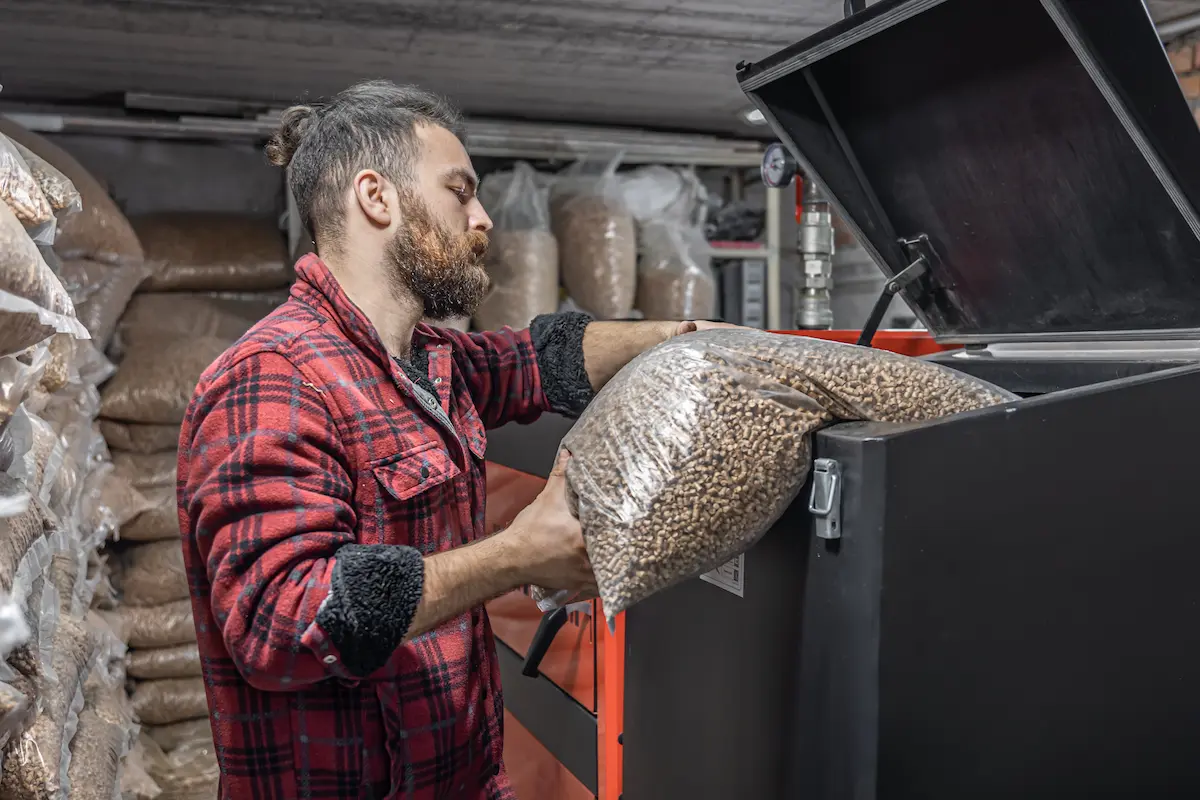
Basically, a biomass boiler is a heating system that produces heat by burning organic materials. However, they work almost like any other boiler: by burning fuel and transferring the heat to the water in the circuit through a heat exchanger, which then reaches your radiators (or underfloor heating, of course).
If you want to familiarise yourself with this energy before learning how biomass boilers work, we recommend reading what biomass is and how it works.
How do Biomass Boilers Work?
A biomass boiler is a heating system that uses renewable organic fuels such as pellets, firewood, wood chips, or olive pits to generate heat. These systems are sustainable, environmentally friendly, and are designed to provide both heating and domestic hot water (DHW). The process begins with the fuel being fed into the combustion chamber, where it ignites and produces heat. Through a heat exchanger, this heat warms the water, which then circulates through the heating system or is stored in tanks for domestic hot water.
The design of these boilers ensures efficient combustion through automated systems that regulate the amount of fuel and oxygen needed. Additionally, they often include self-cleaning systems to reduce maintenance and filters that minimise particle emissions, making them environmentally friendly.
Types of Biomass Boilers
Biomass boilers are categorised into two groups: by technology and by fuel type. The biomass boilers by technology are:
- Standard boilers, which can achieve efficiencies exceeding 90%, up to 92%. They are designed to use a single type of biofuel, which can be firewood, wood chips, or pellets. They are usually automated for self-cleaning of the heat exchanger and include an ash extractor. They are the most common and affordable. Automatic fuel feeding is also available.
- Adapted boilers. Designed to burn fuels with lower calorific value. Their efficiency ranges between 75% and 85%.
- Condensing boilers. They recover the heat contained in the exhaust gases, achieving efficiencies above 100% (in terms of usable energy).
- Hybrid boilers. These combine the use of biomass with other types of energy, such as natural gas or diesel. They offer a versatile solution for homes with variable energy needs. Automatic fuel feeding is included.
Regarding biomass boilers by fuel type, we can differentiate five groups:
- Pellets. Pellets are small cylinders made from compressed wood residues. This type of fuel is the most efficient due to its high density and low moisture content. Ideal for single-family homes because of their constant calorific value and ease of maintenance.
- Firewood. Firewood is the most traditional and economical fuel. It is commonly used in rural areas or locations with direct access to this resource. It requires more storage space and attention in its preparation.
- Wood chips. This type of biomass is bulkier and less dense than pellets, requiring more storage space. They are an excellent option for larger installations such as public buildings or farms.
- Olive pits and other agricultural by-products. These are by-products of the agri-food industry and are a very economical option in countries like Spain, where they are produced locally and consistently. They are cheap, have a high calorific value, and a low carbon footprint.
- Multi-fuel boilers. These boilers can use various types of biomass. They provide medium to high power and are very flexible, depending on the availability of fuel in your region.
Comparison Table: Consumption and Fuel Prices
Now that we know how biomass boilers work, it’s important to understand fuel consumption and operating costs, which vary depending on the type of fuel and the size of the installation. Below, you’ll find a comparison table to help you better evaluate all biomass boiler fuels.
| Fuel | Calorific Value (kWh/kg) | Price (€/kg) | Characteristics |
|---|---|---|---|
| Pellets | 4.8-5 | 0.25-0.30 | High energy density, low moisture content. |
| Firewood | 4-4.5 | 0.10-0.12 | Requires more storage space. |
| Wood chips | 3-4.4 | 0.18-0.22 | Abundant resource in Mediterranean areas or forests. |
| Olive pits and nutshells | 5-5.3 | 0.15-0.20 | Economical and powerful, but less uniform than pellets. |
Efficiency and Performance of Biomass Boilers
The efficiency of a biomass boiler depends on factors such as fuel type, system design, and maintenance. Generally, modern systems have efficiencies between 75% and 90%. Condensing boilers exceed this range, reaching up to 103% by maximising the energy from combustion gases.
Compared to natural gas boilers, biomass boilers tend to be less efficient due to the nature of organic fuels. However, their environmental advantage and stable fuel costs make them a very attractive option.
Advantages of Biomass Boilers
- 100% renewable energy. Local resources can be used, reducing dependence on imported fuels.
- Stable costs. Biomass fuel prices are less volatile than fossil fuels.
- Sustainability. CO2 emissions are lower compared to traditional heating systems. In fact, their cycle is carbon neutral, so they do not contribute to global warming.
- Fuel can be stored for long periods and used as needed.
- Reduces pollutant emissions, such as NOx.
- Simple installation.
- Higher efficiency than a traditional boiler.
- Creates jobs in rural areas.


