
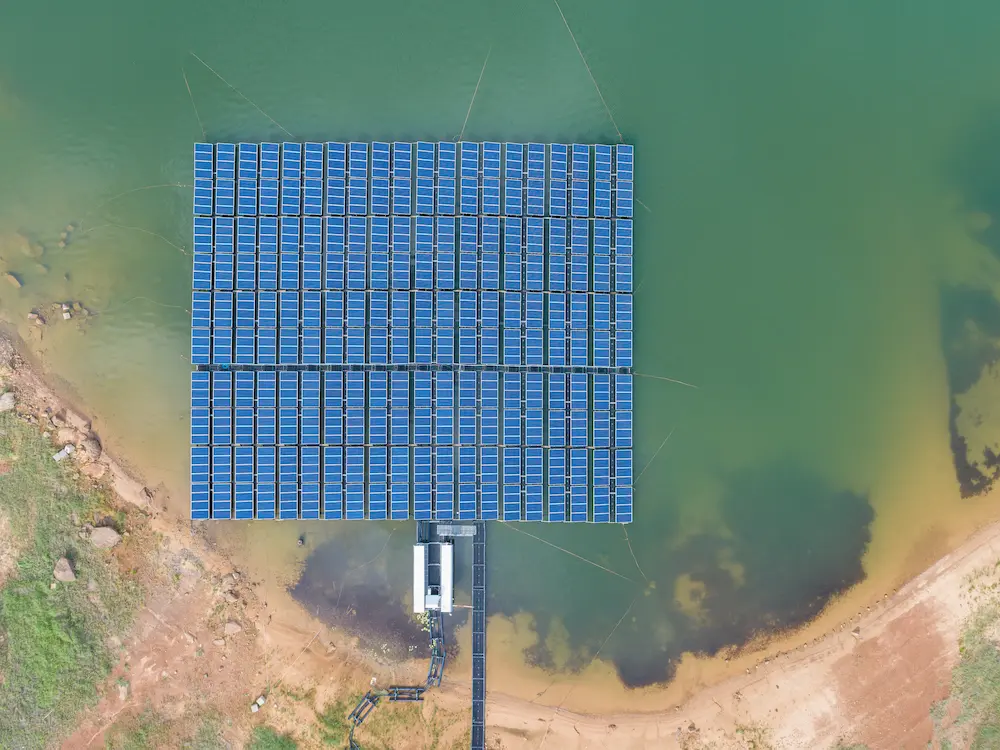
Floating solar energy is revolutionising the renewable energy sector by utilising water surfaces for electricity generation. Instead of occupying valuable land, these installations enable the production of clean and efficient energy on water bodies such as reservoirs, lakes, and, in some cases, the sea. With significant potential to expand renewable generation capacity, floating solar panels offer a practical and sustainable solution to space challenges while enhancing energy efficiency.
What Are Floating Solar Panels?
Floating solar panels are photovoltaic modules installed on platforms designed to float on water. This system, also known as floating photovoltaic (FPV) energy, is deployed on water surfaces like reservoirs, lakes, and artificial water basins.
Compared to land-based systems, floating solar panels provide several advantages, such as reducing water evaporation and achieving higher performance due to natural cooling provided by the water. Additionally, they represent an ideal alternative for regions with limited or unsuitable land for conventional photovoltaic systems.
How Do Floating Solar Panels Work?
The operation of a floating photovoltaic system is similar to that of land-based solar plants, with some key differences arising from their water-based location. Below are the main elements of the system:
Main Components:
- Floating Platform:
- Supports the solar panels and keeps the structure afloat.
- Comes in various types, such as metal structures, floating membranes, or hybrid systems.
- Solar Panels:
- Convert sunlight into electricity.
- Bifacial panels are commonly used for their higher efficiency and moisture resistance.
- Anchoring System:
- Secures the platform to the bottom or shore of the water body.
- Designed to adapt to water level fluctuations.
- Underwater Cabling:
- Connects the energy generated by the solar panels to the electrical grid or storage systems.
- Inverters and Transformers:
- Convert the direct current (DC) generated into alternating current (AC) suitable for consumption.
Process:
- Sunlight hits the solar panels.
- The panels convert the radiation into electrical energy.
- The cabling system transports the energy through inverters and transformers.
- The electricity is stored or sent directly to the electrical grid.
Benefits of Floating Solar Panels
Floating solar panels offer multiple advantages that position them as an innovative and efficient solution for harnessing solar energy:
Key Advantages:
- Space Optimisation: Utilise water bodies instead of land, making them ideal for regions with limited land availability.
- Reduction of Evaporation: Protect water bodies from excessive evaporation, especially in hot climates.
- Natural Cooling: Water helps keep the panels cooler, increasing efficiency and extending their lifespan.
- Control of Algae Growth: Reduce direct sunlight on water, limiting excessive algae growth.
- Prevention of Erosion: Act as physical barriers protecting shorelines from strong winds and erosion.
- Efficient Production: Studies show floating photovoltaics can be 2-3% more efficient than land-based installations.
- Protection of Species: Research has identified benefits for aquatic biodiversity by reducing light and heat impact.
Challenges and Drawbacks of Floating Solar Energy
While this technology is promising, it also presents some challenges that must be considered:
- High Initial Costs:
- Requires specialised floating and anchoring systems, increasing installation costs.
- Complex Maintenance:
- Operations can be more challenging, especially for underwater repairs.
- Environmental Impact:
- Although limited, there may be effects on aquatic biodiversity and water quality if mitigation measures are not implemented.
- Production in Saline Environments:
- Saltwater can reduce panel efficiency due to corrosion and salt accumulation.
- Lack of Experience:
- The technology is still relatively new, leading to uncertainties regarding long-term performance.
Comparison Table: Floating Solar Panels vs. Land-Based Solar Panels
| Feature | Floating | Land-Based |
|---|---|---|
| Space Usage | Utilise water surfaces | Require large land areas |
| Cooling | Natural due to water contact | Limited |
| Initial Cost | Higher | Lower |
| Efficiency | Higher in hot climates | Depends on location |
| Environmental Impact | Potential effects on ecosystems | Impact associated with land use |
| Maintenance | More complex | Less complex |
Floating Solar Energy in Spain
Spain has significant potential for floating solar panel implementation, thanks to its abundance of reservoirs, lakes, and other water surfaces. Examples of projects under development include:
- Zorita (Cáceres):
- First floating installation in Spain.
- 3,000 solar panels over 12,000 m².
- Regantes Andévalo (Huelva):
- Self-consumption system saving energy costs for agricultural irrigation.
- Torrelaguna (Madrid):
- Installation in a small hydroelectric plant with 3,770 solar modules.
- Llíria (Valencian Community):
- Isolated system of 870 kW designed for irrigation.
Frequently Asked Questions (FAQ)
What are floating solar panels?
These are solar panels installed on platforms that float on water bodies, designed to efficiently generate renewable energy.
Where can floating solar panels be installed?
In reservoirs, lakes, dams, and other water bodies, provided they meet the conditions for installation.
How much does it cost to install floating solar panels?
The initial cost is higher than land-based installations due to the floating, anchoring, and underwater cabling systems required.
How long do floating solar panels last?
With proper maintenance, they can have a lifespan of 20 to 25 years, similar to land-based installations.


